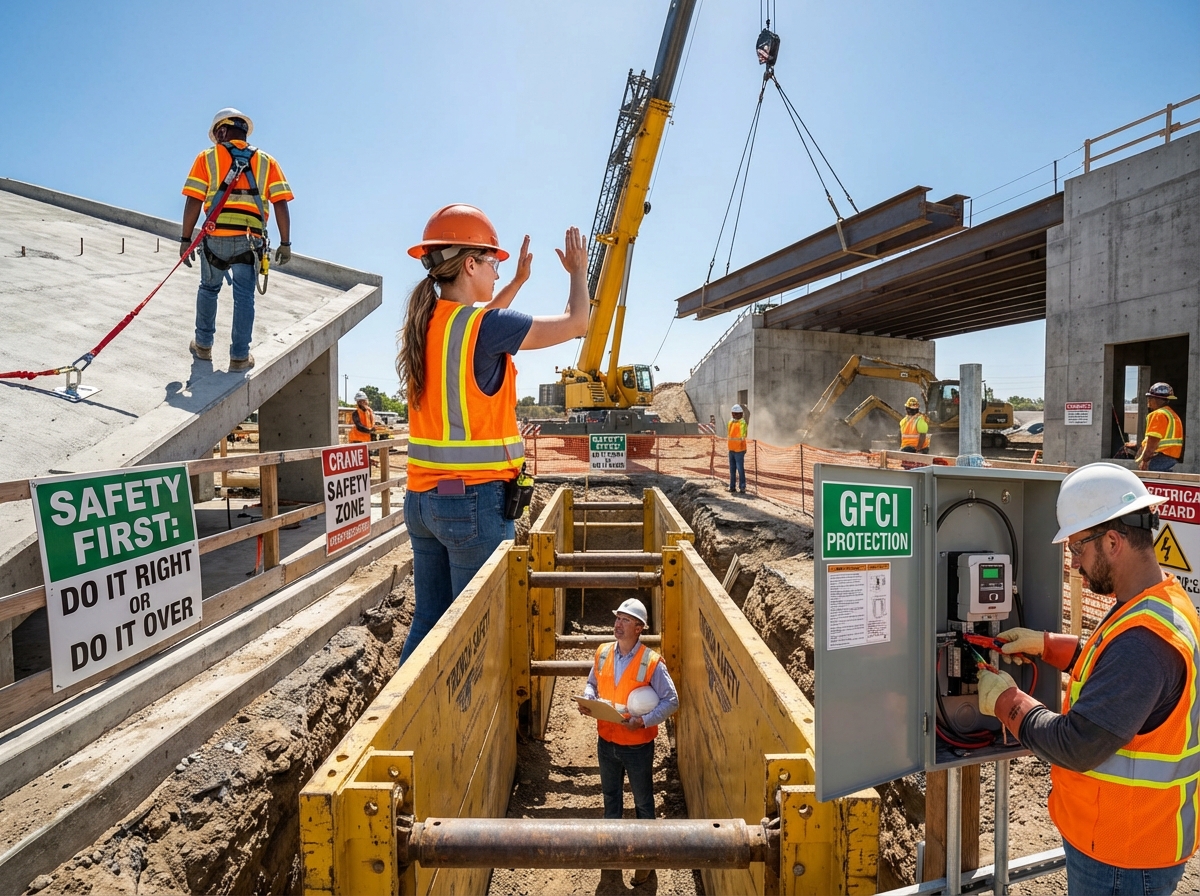
The OSHA Focus Four — falls, struck-by, caught-in/between, and electrocution — account for a large share of construction deaths and serious injuries. This guide explores each hazard in depth and provides practical prevention strategies, regulatory references, inspection checklists, training priorities, and step-by-step controls to reduce risk on construction sites and industrial workplaces.
Why the Focus Four Matter for Construction Safety
Construction sites are high risk by nature. OSHA identifies four specific hazards that account for the majority of site fatalities. These are known as the Focus Four: falls to a lower level, struck-by incidents, caught-in or between hazards, and electrocutions. These categories are the foundation of any effective safety program because they represent the most significant threats to life on the job. Understanding these hazards is the first step in building a culture that prioritizes worker health.
In 2023, construction fatalities reached 1,075. This number represents approximately 20 percent of all worker deaths in the United States. The Focus Four hazards caused 56 percent of those deaths. Falls remain the most dangerous, accounting for 421 deaths in 2023, which is roughly 39 percent of all construction fatalities. Struck-by and caught-in hazards together caused about 10 percent of deaths, while electrocutions added another 6 percent. These numbers show why these hazards get so much attention from regulators and safety managers in 2025.
| Hazard Category | 2023 Fatality Count | Percentage of Construction Total |
|---|---|---|
| Falls to Lower Level | 421 | 39% |
| Struck-By / Caught-In | 111 | 10% |
| Electrocutions | 66 | 6% |
| Total Focus Four | 598 | 56% |
Regulatory Framework and Standards
OSHA uses the 29 CFR 1926 standards to regulate construction. These rules provide the legal framework for prevention. Subpart M covers fall protection, requiring protection when workers are 6 feet or more above a lower level. Subpart P governs excavations, setting rules for trenching and shoring. Subpart CC covers cranes and derricks. These regulations drive prevention by setting specific technical requirements. They force companies to plan work before it starts. Following these rules is not just about compliance; it is about creating a predictable environment where accidents are less likely to happen.
Risk-Based Safety Management
A risk-based safety management approach is the best way to handle these hazards. It starts with hazard identification. Teams look at the site to find where someone could fall or get crushed. Then they perform a risk assessment to determine how likely an accident is and how severe it could be. The hierarchy of controls guides the solution. Elimination is the first choice. If you cannot eliminate the hazard, you use engineering controls like guardrails. Administrative controls and personal protective equipment (PPE) are the last lines of defense. Verification ensures the controls actually work. This cycle must repeat as the site changes.
Stakeholder Roles and Responsibilities
Safety is a shared responsibility, particularly on multi-employer worksites. OSHA policy defines specific roles: the creating employer caused the hazard; the exposing employer is the one whose employees are threatened; the correcting employer is responsible for fixing the problem; and the controlling employer has general supervisory authority. Employers must provide a safe workplace and the right equipment.
A competent person is someone who can identify hazards and has the authority to fix them immediately. They must inspect scaffolds and trenches daily. A qualified person has the recognized degree or professional standing to design systems like fall anchors or electrical layouts. Supervisors manage daily tasks and enforce rules. Employees must follow procedures and report hazards. Clear communication between these groups is essential for a Focus Four Campaign 2025 to succeed.
Recordkeeping and Reporting
Recordkeeping is a legal requirement. Companies must track injuries and near misses to identify trends before a fatal accident happens. Reporting basics include logging incidents on OSHA 300 forms. Serious accidents must be reported to OSHA within specific timeframes. Documentation extends to training as well; for toolbox talks, a simple sign-in sheet is insufficient. Records must list the date, site location, instructor name, specific topics covered, and include employee signatures. Accurate records allow managers to see which controls are failing and where more training is needed.
The Business Case for Prevention
The business case for safety is strong. Accidents cause massive downtime, higher insurance premiums, and increased workers’ compensation costs. A single serious violation can cost over $16,000. Willful violations can exceed $161,000. Beyond money, safety impacts workforce morale. Workers who feel safe are more productive and stay with the company longer, reducing turnover and training costs. A strong safety record also makes a company more competitive when bidding for new projects.
The following chapters will provide concrete measures for each hazard. We will start with the most frequent cause of death. The next section covers practical systems and procedures for preventing falls, including checklists and specific program elements to keep workers safe at heights.
Preventing Falls Practical Systems and Procedures
Falls remain the most frequent cause of death on construction sites. We must look at every elevated work area as a potential risk. This includes roofs, leading edges, floor openings, and scaffolds. Identifying these hazards starts with a walk-through before work begins. You need to look for unprotected sides and find holes in the floor that are larger than two inches. Any surface that is not strong enough to support workers must be marked. This is the first step in a risk-based safety approach.
The Hierarchy of Controls
We always try to eliminate the hazard first. This might mean doing work on the ground before lifting a structure into place. If we cannot eliminate the risk, we use engineering controls. Guardrails are the most common engineering control because they provide a physical barrier that does not require worker action to stay safe. Administrative controls come next, such as warning lines or limiting who can enter a high-risk zone. Personal fall arrest systems (PFAS) are the last line of defense, used when other methods are not possible. Every site should aim to move up this hierarchy to find the safest solution.
Guardrail Systems and Safety Nets
A standard guardrail system must meet specific strength rules. The top rail needs to be 42 inches high (plus or minus 3 inches) and must withstand 200 pounds of force. The mid rail sits at 21 inches. Toeboards are necessary to stop tools from falling on people below. Safety nets are another option for large open areas. These nets must be installed as close as possible under the work surface and never more than 30 feet below. We test these nets by dropping a 400-pound bag of sand into them. This drop test happens after installation and then every six months.
Personal Fall Arrest Systems
A personal fall arrest system has three main parts: the anchorage, the harness, and the connector. The anchorage is the most critical part; it must support 5,000 pounds for each worker attached to it. Connectors like D-rings and snap-hooks must be made of drop-forged steel. Lifelines should be protected from sharp edges. Energy absorbers are vital because they reduce the force on the body during a fall. A harness must fit the worker perfectly with snug straps. If a harness is too loose, it can cause internal injuries during a fall. Workers must inspect their gear before every single use.
Scaffold and Ladder Safety
Scaffolds require a competent person for oversight. This person has the authority to stop work if they see a hazard and must inspect the scaffold before every shift. They check for stable mud sills and ensure the platform is fully planked with no gaps larger than one inch. Ladders also need daily checks. We look for cracked rungs or broken spreaders. If a ladder is defective, we tag it as “Do Not Use” and remove it from the site. Workers must always keep three points of contact when climbing (two hands and one foot, or two feet and one hand).
Specialized Tasks and Rescue Planning
Roofing work often requires specialized controls like slide guards or static lines. Steel erection has different rules; while workers might be allowed to work up to 15 or 30 feet without traditional protection in some cases, 2025 standards push for 100 percent tie-off at 6 feet. Facade work often uses swing stages, which require secondary lifelines that are independent of the scaffold. Every site needs a rescue plan. A worker hanging in a harness can lose consciousness in minutes due to suspension trauma. The plan must include ways to reach the worker quickly without putting rescuers at risk. You can find more details on these requirements in the OSHA Fall Hazards Guide.
| Inspection Item | Requirement | Frequency |
|---|---|---|
| PFAS Harness | No frayed stitching or burns | Before every use |
| Scaffold Planking | Grade lumber, no gaps | Daily before shift |
| Anchorage Point | Rated for 5,000 lbs | At installation |
| Guardrail Height | 42 inches (+/- 3 inches) | Weekly audit |
Tracking Performance and Training
We measure success by tracking key metrics. Near-miss reports tell us where a fall almost happened. We also track how many inspections are completed on time. The time it takes to close a corrective action is another important KPI. If a broken guardrail stays broken for three days, the system is failing. Training is the foundation of this work. Workers need to know how to don a harness and how to calculate fall clearance. This calculation must include the length of the lanyard, the deceleration distance, and a safety factor. Regular audits should happen monthly to ensure these procedures are followed in the field.
Preventing Struck By Hazards Controls for People and Equipment
Struck-by hazards remain a primary threat on every job site. Statistics show that struck-by injuries account for roughly 17 percent of fatal construction injuries. These events involve vehicles, falling objects, swinging equipment, or flying debris. Preventing these accidents requires a combination of strict site planning and physical barriers.
Vehicle and Mobile Equipment Safety
Vehicle safety starts with a comprehensive site traffic plan. This plan defines designated routes for heavy machinery and keeps pedestrian paths separate from truck lanes. Speed limits on construction sites should never exceed 5 miles per hour. High visibility clothing is a mandatory requirement for every person on the ground; workers must wear ANSI Class 2 or Class 3 vests to stay visible in all lighting conditions. Daily vehicle maintenance checks ensure that brakes and steering systems function correctly. Backup alarms are required to produce a sound audible above the surrounding noise (typically 87–112 decibels). Many modern sites now use 360-degree camera systems to eliminate operator blind spots. Spotters are necessary whenever equipment moves in tight spaces. The spotter must maintain constant eye contact with the operator. If the operator loses sight of the spotter, they must stop the vehicle immediately.
Crane and Hoisting Operations
Cranes involve complex risks from swinging loads. Every lift requires a formal lift plan. This plan uses lift charts to verify the crane can handle the weight at a specific radius. OSHA standard 1926.1428 requires qualified signalpersons for all hoisting tasks. These individuals must understand standard hand signals and radio protocols. Tag lines are essential for controlling the load to prevent material from spinning or swinging into structures. Exclusion zones must be established around the entire swing radius. A common best practice is to set the exclusion zone at twice the radius of the load. Daily inspections by a competent person are mandatory before the first lift of the shift. You can find more resources on these requirements through the Focus Four Campaign 2025 – Maryland Department of Labor.
Falling Object Controls
Gravity turns small tools into deadly projectiles. Toe boards are required on all scaffold platforms to prevent items from being kicked off the edge. Debris nets provide a secondary layer of protection and should extend at least 8 feet beyond the working edge. Tool lanyards or tethers are now a standard safety tool; these lanyards must be rated for at least twice the weight of the tool. Material storage protocols require that stacks stay stable. Keep all materials at least 6 feet away from unprotected edges. Overhead protection like sidewalk sheds or canopies protects workers in high traffic areas. Exclusion zones must be marked with red tape below any overhead material handling.
Flying Debris Management
Cutting, grinding, and demolition tasks create flying particles that cause eye and face injuries. Grinders must have guards that cover the upper half of the wheel. Portable screens can block sparks and chips from reaching nearby workers. Personal protective equipment is the final defense. This includes safety glasses with side shields and full face shields for high impact tasks.
Coordination and Communication
Multiple trades working in the same area increase the risk of struck-by events. Coordination meetings happen every morning to discuss scheduled lifts. Lift permits are issued for any critical or heavy hoisting. Hot work permits manage the risks of cutting and welding. Communication systems like dedicated radio channels keep ground crews in touch with operators. Clear signage must be posted at every vehicle entrance and exit point.
| Checklist Category | Critical Safety Items |
|---|---|
| Vehicle Arrival | Verify backup alarm. Check high vis gear. Confirm site speed limit. |
| Pre-Lift Brief | Review lift chart. Identify signalperson. Clear exclusion zone. |
| Tool Tethering | Inspect lanyard condition. Check anchor point. Verify weight rating. |
Investigation and Performance Monitoring
When a struck-by event occurs, the investigation must look at the line of fire. Was the worker in a restricted zone? Was the equipment maintained? Performance indicators help track the effectiveness of these controls. Safety managers should monitor the number of near miss reports related to vehicle movement and track the time it takes to close corrective actions from site audits. Regular leadership safety walks help identify new hazards before they cause an injury.
Sample Tool Tethering Protocol
1. Select a lanyard rated for the tool weight.
2. Attach the lanyard to a secure wrist strap or tool belt.
3. Ensure the connection point on the tool is structural.
4. Test the reach to ensure it does not interfere with work.
5. Replace any lanyard that has sustained a drop.
Preventing Caught In Between Hazards Trenching and Equipment Safety
Caught-in/between hazards represent a persistent threat on modern jobsites. While struck-by incidents involve the impact of an object, caught-in events occur when a person is squeezed, pinched, or crushed between two surfaces. As we move through 2025, the industry continues to struggle with trench collapses and machinery entanglement. These accidents are often fatal because the pressure exerted by soil or heavy equipment leaves no room for escape.
Trenching and Excavation Controls
Soil Classification
Every excavation project must begin with a soil analysis. A competent person must perform at least one visual and one manual test to determine the soil type. Type A soil is cohesive and has high compressive strength. Type B soil is less stable and includes silt or sandy loam. Type C is the most dangerous and consists of granular soil or submerged rock. If the soil is not classified, it must be treated as Type C. This classification dictates the angle of sloping or the type of shoring required to prevent a cave-in.
Protective Systems
OSHA requires protection for any trench five feet deep or greater. Sloping involves cutting the trench walls at an angle away from the excavation. Benching creates a series of steps to prevent soil from sliding. Shoring uses hydraulic or mechanical systems to support the walls from the inside. Trench boxes are commonly used to protect workers within a specific area. It is important to remember that trench boxes are designed to protect people from a collapse but do not actually prevent the walls from moving. The space between the box and the trench wall should be backfilled to prevent lateral movement. Trench boxes should never sit more than 2 feet (24 inches) above the floor of the excavation to prevent soil from entering from below.
Competent Person and Egress
A competent person must inspect every trench daily before work begins. They must also inspect the site after every rainstorm or any event that could change the stability of the soil. Safe egress is a non-negotiable requirement. For any trench four feet deep or more, a ladder or ramp must be located within 25 feet of lateral travel for every worker. This ensures a quick exit if the walls begin to shift. Utility locating is the final piece of the puzzle. All underground lines must be marked by the utility owners before any digging starts. Striking a buried line can cause a collapse or create an immediate fire hazard.
Machinery and Equipment Safety
Machine Guarding and Entanglement
Stationary and mobile equipment often have rotating parts that can snag loose clothing or hair. All belts, gears, and shafts must have physical guards. If a guard is removed for maintenance, the machine must be locked out. Lockout/tagout (LOTO) procedures in construction require coordination between different trades. A worker should never attempt to clear a jam or perform a repair while the machine is energized. Pinch points are another major concern; these are areas where a person can be caught between moving parts or between a moving part and a fixed object. Marking these areas with high visibility paint helps maintain awareness.
Crushing Prevention
Workers are often crushed between heavy equipment and fixed structures like walls or jersey barriers. Operators must maintain a 360-degree view of their surroundings. When visibility is limited, a dedicated spotter is required. Physical barriers should be used to create exclusion zones around the swing radius of excavators and cranes. Proximity alarms are becoming standard on 2025 jobsites to alert operators when a ground worker enters a danger zone. These systems provide an extra layer of protection when noise levels are high.
Planning and Performance Monitoring
Pre-Task Planning and Permits
Every high-risk task requires a permit-to-work system. This includes excavations deeper than five feet and complex heavy equipment operations. The permit ensures that all safety checks are completed before the task starts. Emergency rescue planning is a critical part of this process. If a trench collapses, ground workers should never attempt to jump in and dig out a coworker, as this often leads to multiple fatalities. A formal rescue plan must include the contact information for specialized rescue teams and the location of emergency equipment.
Safety Performance Indicators
Measuring safety success goes beyond counting accidents. Companies should track the number of daily trench inspections completed. They should also monitor the time it takes to close out a corrective action for a missing machine guard. Near miss reports regarding equipment pinch points provide valuable data for training. According to Focus Four Injuries – CPWR, these hazards remain a top cause of death, so consistent monitoring is essential.
Practical Inspection Checklist
| Inspection Category | Critical Checkpoints |
|---|---|
| Trench Inspection | Soil classification confirmed. No signs of tension cracks. Water accumulation removed. |
| Protective Systems | Shoring is tight and secure. Trench box is not damaged. 24 inch max floor clearance met. |
| Access and Egress | Ladders extended 3 feet above grade. Ladder within 25 feet of all workers. |
| Machine Guarding | All rotating parts covered. Guards are secured. LOTO devices available. |
| Equipment Operation | Spotters in place for blind spots. Swing radius barricaded. Alarms functional. |
Training for operators and ground workers must be specific to the equipment on site. Operators need to understand the load charts and stability limits of their machines. Ground workers must be trained to stay out of the line of fire and recognize the warning signs of a trench failure. Regular toolbox talks should reinforce these concepts to keep safety at the forefront of every shift.
Preventing Electrocution Hazards Electrical Safety Practices
Electrocution remains one of the most persistent threats on modern job sites. While the previous chapter focused on the physical entrapment risks of caught-in hazards, electrical dangers are often invisible until a circuit is completed through a worker. These incidents are almost always preventable through strict adherence to established safety protocols and the use of modern protective technology.
Risk Sources and Site Assessment
The most common sources of electrocution involve contact with overhead power lines. Cranes, ladders, and scaffolding are frequent conduits for these fatal currents. Buried utilities also pose a significant risk during excavation. Before any digging begins, workers must locate and mark all underground lines. Temporary power distribution equipment and portable tools are another major concern. These items are often subjected to harsh weather and heavy use, which leads to damaged insulation or broken ground connections. Energized circuits during installation and testing phases require extreme caution. Even a standard 120-volt circuit can deliver a fatal shock if the conditions are right.
Engineering Controls and Safe Practices
De-energizing equipment is the most effective way to prevent accidents. Lockout and tagout procedures ensure that power stays off while work is performed. If de-energizing is not possible, workers must establish and enforce minimum approach distances to live conductors. For lines up to 50kV, a minimum clearance of 10 feet is required. Ground Fault Circuit Interrupters (GFCIs) are mandatory for all temporary 120-volt 15 or 20-amp receptacles. These devices monitor the flow of electricity and shut off the circuit in a fraction of a second if a leak is detected. Proper grounding plus bonding of all electrical systems provides a safe path for stray current. Insulation and guarding of energized parts prevent accidental contact. Workers should always use insulated tools and appropriate personal protective equipment when working near live parts.
Planning Near Power Lines
Working near high-voltage lines requires a detailed plan. The first step is to contact the utility owner to discuss the scope of work. They may be able to de-energize the lines or install insulating blankets. Physical barriers should be erected to prevent equipment from entering the danger zone. Proximity alarms can be installed on cranes and aerial lifts to warn operators when they get too close to a line. A dedicated spotter is often necessary to maintain safe clearances. This person has the sole responsibility of watching the equipment and the power lines to prevent contact.
Inspections and Maintenance
Extension cords and portable tools need a visual inspection before every shift. Look for frayed jackets, exposed wires, or missing ground prongs. If a cord is damaged, it must be tagged “Do Not Use” and removed from the site immediately. Temporary power distribution boxes should be checked weekly for proper grounding and GFCI functionality. GFCIs require a monthly test using the built-in test button to ensure they trip correctly. According to the OSHA Fatal Four Hazards data, equipment failure is a leading cause of electrical incidents. Regular testing ensures that safety devices will work when they are needed most.
Qualified Workers and Training
OSHA defines a qualified worker as someone who has received specific training on the construction and operation of electrical equipment. These individuals must know how to identify and avoid the hazards involved. Non-qualified workers should be trained to recognize electrical threats and stay away from energized areas. Training should cover the requirements of NFPA 70E, including arc flash labeling and the use of flame-resistant clothing. The Construction Focus Four Training curriculum provides a solid foundation for these safety programs.
Monitoring and Metrics
Tracking safety performance helps identify gaps in the program. Managers should monitor the number of energized work permits issued and the results of GFCI performance checks. Corrective action timelines are also important. If a hazard is identified, it must be fixed quickly to prevent an accident.
| Metric Category | Performance Indicator | Target Frequency |
|---|---|---|
| Compliance | Energized Work Permits | Per Task |
| Equipment | GFCI Performance Checks | Monthly |
| Maintenance | Cord Inspection Logs | Daily |
| Response | Corrective Action Closure | Within 24 Hours |
Emergency Response to Electrical Incidents
If an electrical incident occurs, the first priority is to ensure the area is safe for rescuers. Never touch a victim who is still in contact with a live circuit. Turn off the power at the source if possible. Use a non-conductive object to move the victim away from the wire only if the power cannot be cut. Call emergency services immediately. Provide clear information about the nature of the injury and the voltage involved. Prompt medical attention is critical because electrical shocks can cause internal damage that is not immediately visible.
Conclusions and Next Steps for Safer Sites
The reality of construction safety in 2025 remains centered on the same critical risks that have challenged the industry for decades. Data from 2023 shows that 1,075 workers lost their lives on the job, which represents 20 percent of all occupational deaths in the United States. Within those numbers, the Focus Four hazards continue to be the primary threat. Falls, struck-by incidents, caught-in or between accidents, and electrocutions were responsible for 56 percent of those fatalities. These figures highlight why a structured approach to prevention is not just a regulatory requirement but a moral necessity for every site manager.
Hazard Recognition as the Foundation
Preventing these tragedies begins with the ability to see a hazard before it causes an injury. Recognition requires more than a casual glance at the work area. It involves a systematic review of the environment to identify unprotected edges, unstable soil, or energized equipment. When workers and supervisors are trained to spot these specific threats, they can intervene before a mistake happens. This proactive stance is the first line of defense against the 421 fall-related deaths recorded in 2023.
Applying the Hierarchy of Controls
Once a hazard is identified, the method of control determines the level of safety. Relying solely on personal protective equipment is a common mistake that leaves workers vulnerable. The hierarchy of controls dictates that we should first try to eliminate the hazard entirely. If elimination is not possible, engineering controls like guardrails or trench boxes should be the next choice. Administrative controls plus safe work procedures come after, with personal fall arrest systems acting as the final layer of protection. This structured thinking ensures that safety does not depend entirely on individual behavior.
The Role of Competent and Qualified Personnel
Safety performance relies heavily on the expertise of the people on site. There is a legal and practical difference between a competent person and a qualified person. A competent person has the authority to stop work and the knowledge to recognize hazards in specific areas like scaffolding or excavations. A qualified person possesses the technical degree or professional standing to design complex systems. Using the wrong person for these roles increases the risk of structural failure or electrical accidents.
Emergency and Rescue Planning
Planning for the worst-case scenario is a vital part of the prevention guide. If a worker falls and is suspended in a harness, the clock starts immediately. A rescue plan must be in place to retrieve that worker within minutes to prevent suspension trauma. Similarly, emergency procedures for trench collapses or electrical shocks must be practiced and understood by everyone on the crew. Having the equipment on site is useless if no one knows how to use it during a crisis.
Conducting a Focus Four Gap Analysis
Safety managers should begin their next steps by performing a gap analysis. This process involves comparing current site practices against OSHA standards such as 29 CFR 1926 Subpart M for falls or Subpart P for excavations. By identifying where the site falls short, managers can allocate resources to the highest risks. This analysis should be documented to track improvements over time.
Implementing Daily Inspection Routines
Consistency is the key to maintaining a safe site. Daily inspection routines for ladders, scaffolds, and heavy equipment ensure that wear and tear do not turn into a fatal flaw. Using a standardized checklist helps supervisors stay focused on the most common points of failure. For example, checking that a ladder is tagged correctly or that a trench has a safe means of egress every 25 feet can prevent the types of accidents that make up the 10 percent of deaths caused by struck-by and caught-in hazards.
Measuring Progress with Key Performance Indicators
To improve safety, you must measure it. Moving beyond lagging indicators like injury rates allows managers to see the health of their safety program in real time. Tracking the number of near-miss reports, the time it takes to close out a corrective action, and the frequency of toolbox talks provides a clearer picture of site safety. These metrics help identify trends before they lead to an actual incident.
Continuous Improvement and Leadership
Safety is a continuous process that requires leadership involvement. Periodic safety walks by senior management demonstrate that protection is a core value of the company. After-action reviews following a near-miss provide a way to learn from mistakes without the cost of an injury. Integrating contractor safety into the initial project planning ensures that every person on a multi-employer site follows the same high standards. You can find more resources on these initiatives through the Focus Four Campaign which provides updated materials for 2025.
| Action Item | Frequency | Responsible Party |
|---|---|---|
| Focus Four Gap Analysis | Quarterly | Safety Manager |
| Scaffold and Ladder Checks | Daily | Competent Person |
| Toolbox Talks on Focus Four | Weekly | Field Supervisor |
| Rescue Drill Practice | Bi-Annually | Entire Crew |
Your immediate goal is to select one specific control or checklist item from this guide and implement it on your site tomorrow. Whether it is a new trench inspection form or a more rigorous GFCI testing schedule, commit to tracking its impact for the next 30 to 90 days. Monitor the compliance levels and gather feedback from the workers using the system. Small, consistent changes in how we handle the Focus Four hazards are what ultimately bring the fatality numbers down and ensure every worker returns home.
Sources
- Focus Four Campaign 2025 – Maryland Department of Labor — The leading causes of worker deaths on construction sites were falls, followed by caught-in/between combined with struck-bys, and electrocutions. These "Fatal …
- OSHA Fatal Four Hazards: What To Know In 2025 — OSHA's FATAL Fthe OSHA · Fall accidents lead to 36.5% of deaths in the construction industry · Electrical Hazard leads to 8.5% of deaths in the …
- Understanding OSHA's “Fatal Four” Hazards in Construction — 1. Falls: The Leading Cause of Death … Falls are the most frequent cause of fatalities in construction, accounting for 38.5% of all construction deaths in 20231 …
- Construction Safety Statistics (2025) — Alarming construction safety stats revealed. Learn about top hazards, injury rates, & prevention to create a safer job site.
- 41 Construction Safety Statistics for 2025 – Claris Design Build — Hazardous noise impacts 51% of construction workers while increasing heat conditions pose a growing risk of injury and death. ✓ Working with reputable …
- [PDF] Data Bulletin APRIL – CDC Stacks — Focus Four – Defined by OSHA as the four injuries that cause the most fatalities among construction workers, including falls to a lower level, struck-by …
- OSHA's “Fatal Four” – The leading causes of death in the … — The “Fatal Four” leading causes of construction deaths – falls, stuck-by, electrocutions, and caught-in or -between — are preventable by using these tips.
- Focus Four Injuries – CPWR — The construction Focus Four are the four injury types that combined cause almost two-thirds of on-the-job fatalities among the industry's workers (see below). …
- Construction Focus Four Training | Occupational Safety and … – OSHA — The Construction Focus Four Training consists of lesson plans on each of the Focus Four Hazards. Each lesson plan was developed based on specific learning …
- [PDF] Construction Focus Four: Fall Hazards – OSHA — In 2009, falls accounted for more than one- third of fatal occupational injuries in construction. (34%). Nearly half (48%) of all fatal falls in private.
EMPTY