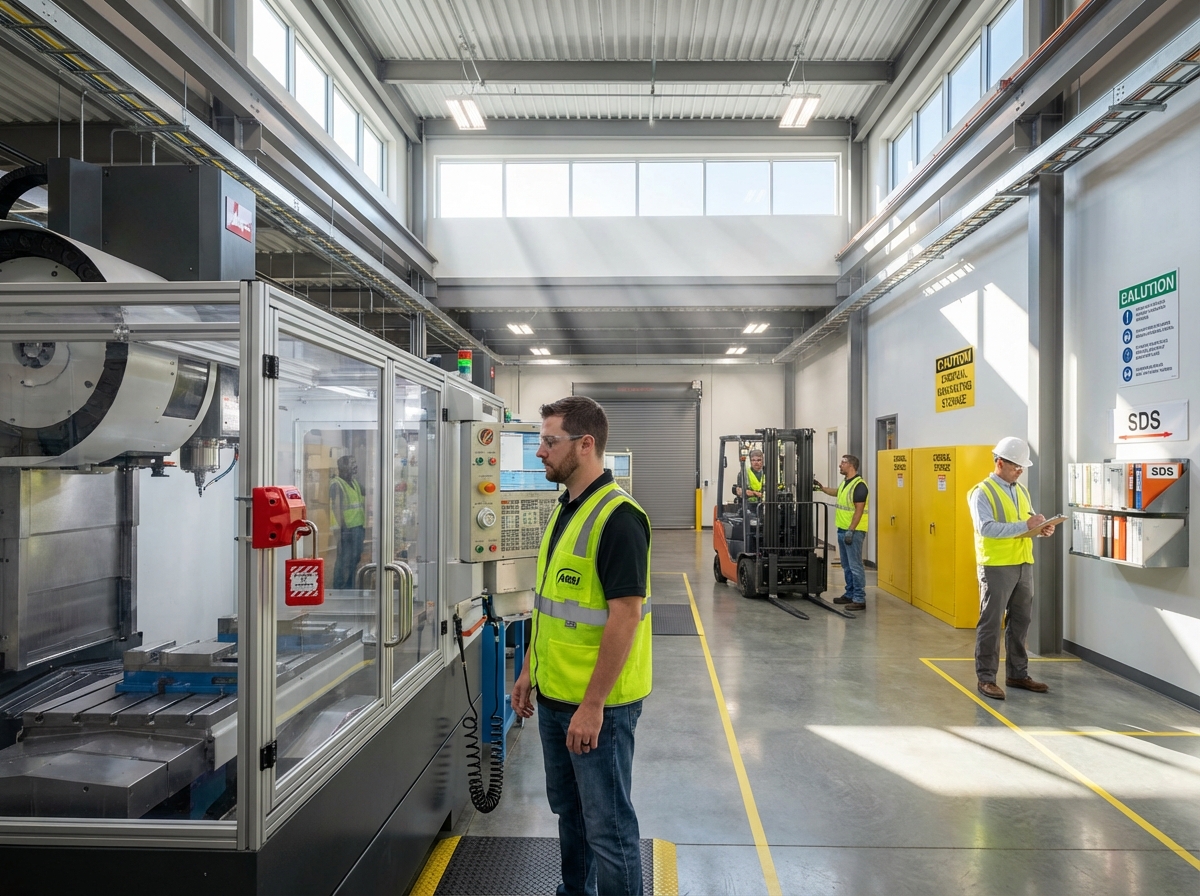
Manufacturing remains high-risk for OSHA citations and workplace injuries. This article identifies the ten most frequently cited OSHA violations in manufacturing, explains why they occur, and provides step-by-step prevention tactics, compliance program elements, and measurable controls managers can implement to reduce risk, lower citation exposure, and improve safety performance across plants, warehouses, and production lines.
Top 10 Most Cited Violations in Manufacturing and How to Prevent Each
Manufacturing facilities face a specific set of hazards that frequently draw the attention of federal inspectors. The most recent inspection cycles show a recurring pattern: citations often stem from a gap between written safety policies and the actual daily habits of workers on the assembly line. By focusing on these ten specific standards, plant managers can move from a reactive stance to a proactive safety culture, protecting their workforce while avoiding heavy financial penalties.
1. Machine Guarding (Standard 1910.212)
The Hazard and Common Findings
This standard is a constant challenge in environments with stamping presses, conveyors, and CNC machines. Inspectors often find that guards have been removed for maintenance and never replaced, or that they are positioned in a way that allows workers to reach around them. A common scenario involves a worker attempting to clear a scrap piece from a press or bypass interlocks on conveyor systems to clear jams while the machine is still in motion. OSHA frequently cites machines that are not anchored to the floor or those with rotating parts that remain exposed during operation.
Prevention and Controls
To prevent this, plants should install interlocked guards that automatically cut power when opened. Long-term engineering controls include light curtains or pressure mats that stop equipment if a person enters the danger zone. A quick win is to conduct a floor walk to ensure every rotating part is physically shielded and that every bench grinder has a work rest adjusted to within one-eighth of an inch from the wheel.
- Checklist Item: Are all pulleys, belts, and nip points fully enclosed?
- Training: Conduct initial machine-specific safety training and annual refreshers.
- Documentation: Maintain guarding audit logs and maintenance records.
- KPI: Percentage of machines with verified functional interlocks during weekly audits.
2. Hazard Communication (Standard 1910.1200)
The Hazard and Common Findings
Citations for Hazard Communication often involve missing safety data sheets (SDS) or unlabeled secondary containers in paint booths and chemical storage areas. If a worker pours a solvent into a smaller spray bottle without a label, it creates a significant risk. Inspectors also frequently find outdated chemical inventories that do not match the substances actually present on the shop floor.
Prevention and Controls
Managers should maintain a digital library of safety data sheets accessible to every employee on every shift via tablets or kiosks. A quick fix is to provide pre-printed GHS labels at every chemical station. Training must focus on reading labels and understanding the specific health risks of chemicals used on-site.
- Checklist Item: Does every secondary container have a compliant GHS label?
- Training: GHS label recognition and chemical-specific hazards upon hire.
- Documentation: Written HazCom plan and an up-to-date chemical inventory list.
- KPI: Accuracy rate of the chemical inventory during monthly spot checks.
3. Control of Hazardous Energy / Lockout Tagout (Standard 1910.147)
The Hazard and Common Findings
Failure to properly manage energy during maintenance is a leading cause of amputations, especially on complex assembly lines where multiple energy sources exist. Inspectors frequently cite companies for lacking machine-specific procedures or for failing to conduct annual inspections of their lockout programs. A common finding is employees performing minor repairs without using a lock because they believe the task is too short to justify the time.
Prevention and Controls
Provide every authorized employee with their own uniquely keyed lock. Create visual LOTO cards with photos showing exactly where the energy isolation points are for each machine. Long-term strategies involve installing energy isolating devices that are easier to access.
- Checklist Item: Are machine-specific procedures posted directly at the equipment?
- Training: Hands-on authorized employee training vs. affected employee awareness training annually.
- Documentation: Annual inspection certification of LOTO procedures for each machine.
- KPI: Number of LOTO audits performed versus scheduled.
4. Respiratory Protection (Standard 1910.134)
The Hazard and Common Findings
In welding shops and paint booths, respiratory protection is vital. Citations often stem from a lack of medical evaluations or improper storage of masks. If a worker wears a respirator without a fit test, they may not be getting the protection they need. Inspectors often find dirty respirators stored in open lockers rather than sealed bags, exposing the equipment to contamination.
Prevention and Controls
Implement a mandatory medical clearance process before any worker puts on a tight-fitting respirator. Conduct annual fit testing for all required users. A quick win is to provide sealed storage bags to keep respirators clean when not in use. Long-term solutions might include improved local exhaust ventilation to reduce the need for respirators.
- Checklist Item: Are respirators stored in a clean, dry, and sanitary environment?
- Training: Proper donning, doffing, and cleaning procedures.
- Documentation: Medical clearance forms and current fit test records.
- KPI: Percentage of required employees with current fit tests.
5. Powered Industrial Trucks (Standard 1910.178)
The Hazard and Common Findings
Forklifts in warehouses and plants are high-risk equipment. Common findings include operators driving with elevated loads, failing to perform daily inspections, or operating with expired certifications. Inspectors also look for damaged overhead guards or trucks with non-functional backup alarms.
Prevention and Controls
Every operator must be trained and evaluated every three years. A quick fix is to implement a digital checklist system that prevents the truck from starting until the inspection is finished. Long-term controls include installing speed limiters and blue safety lights to warn pedestrians of approaching vehicles.
- Checklist Item: Are forks free of cracks and visible wear?
- Training: Classroom and practical evaluation every three years.
- Documentation: Daily inspection logs and copies of operator certifications.
- KPI: Number of forklift-related near misses reported.
6. Electrical Safety and Wiring (Standards 1910.303 and 1910.305)
The Hazard and Common Findings
Electrical violations often involve blocked panels or the use of extension cords as permanent wiring for fans or small tools. In many plants, boxes or pallets are stacked in front of electrical rooms, preventing emergency access. Inspectors also look for missing knockout plugs in junction boxes and frayed cords on portable power tools.
Prevention and Controls
Ensure a 36-inch clear space in front of all panels at all times; painting yellow lines on the floor to mark these zones is an effective quick win. Long-term engineering involves adding permanent outlets to eliminate the need for extension cords.
- Checklist Item: Are all junction boxes covered and panels accessible?
- Training: Basic electrical safety and cord inspection for non-qualified workers.
- Documentation: Records of annual infrared thermography on panels.
- KPI: Number of temporary cords found during weekly walkthroughs.
7. Personal Protective Equipment and Eye Protection (Standards 1910.132 and 1910.133)
The Hazard and Common Findings
Eye injuries are common in metalworking and assembly where flying debris is present. Citations occur when companies fail to perform a hazard assessment to determine necessary PPE or when workers refuse to wear safety glasses. OSHA often finds workers wearing their own prescription glasses instead of rated safety eyewear.
Prevention and Controls
Conduct a written hazard assessment for every job title. Provide a variety of comfortable eyewear options, including a prescription safety glass program, to encourage use. Establish mandatory PPE zones with clear signage.
- Checklist Item: Is the required PPE available and in good condition?
- Training: Specific hazards of each task and proper PPE care.
- Documentation: Signed hazard assessment for each department.
- KPI: PPE compliance rate observed during random safety audits.
8. Walking-Working Surfaces (Standard 1910.22)
The Hazard and Common Findings
Housekeeping is a major factor in slip and fall citations. Oil leaks from CNC machines, water near wash stations, or cluttered aisles that block exit routes create dangerous conditions. The standard requires floors to be kept clean and dry, and inspectors often find uneven surfaces or unrepaired floor cracks.
Prevention and Controls
Use drip pans and absorbent mats in known leak areas. Implement a 5S program to keep tools and materials in designated spots. Long-term fixes include repairing floor cracks and applying non-slip coatings.
- Checklist Item: Are all aisles and exits clear of obstructions?
- Training: Slip, trip, and fall prevention for all staff.
- Documentation: Floor maintenance and cleaning schedules.
- KPI: Time elapsed between a spill report and its cleanup.
9. Process Safety Management (Standard 1910.119)
The Hazard and Common Findings
Facilities handling large quantities of hazardous chemicals must follow strict protocols. Citations often involve outdated piping and instrumentation diagrams (P&IDs) or a failure to perform five-year revalidations of process hazard analyses (PHA). OSHA also looks for gaps in mechanical integrity programs for pressure vessels.
Prevention and Controls
Maintain a rigorous schedule for equipment inspections and ensure any change to the process goes through a formal Management of Change (MOC) review. A quick win is to audit current chemical volumes to ensure they are within safe limits.
- Checklist Item: Are all pressure relief valves within their test dates?
- Training: Process-specific safety for operators and contractors.
- Documentation: Process Hazard Analysis and mechanical integrity reports.
- KPI: Percentage of overdue mechanical integrity inspections.
10. Occupational Noise (Standard 1910.95)
The Hazard and Common Findings
Stamping plants and high-speed assembly lines often exceed safe noise levels. Citations happen when companies fail to provide annual audiograms or do not have a written hearing conservation program when noise exceeds 85 decibels. A frequent finding is the lack of baseline audiograms for new hires.
Prevention and Controls
Conduct noise mapping to identify high-decibel zones and provide high-quality earplugs or earmuffs. Long-term engineering includes installing acoustic enclosures around loud machinery.
- Checklist Item: Are hearing protection zones clearly marked with signs?
- Training: Annual hearing conservation and proper earplug insertion.
- Documentation: Annual audiometric testing and noise dosimetry results.
- KPI: Percentage of employees showing no significant threshold shift.
Designing a Compliance Driven Safety Management System
Building a safety management system that actually works requires moving past simple compliance. It means creating a structure where safety is part of every production meeting and every maintenance shift. This system must address the most common failures by making the right way the only way to do the job. A strong system relies on written programs that people actually read and follow.
Integration of Written Programs
Written programs for high-risk activities—specifically Lockout Tagout (LOTO), Hazard Communication, and Respiratory Protection—must be living documents. They need a clear owner who updates them when equipment changes or new chemicals enter the facility. For example, a LOTO program is not compliant if it only contains a general policy; it must include machine-specific procedures that are verified annually. Similarly, Hazard Communication programs must be cross-referenced quarterly against purchasing records to ensure the chemical inventory matches reality.
Hazard Identification and Risk Assessment
Routine inspections are the first line of defense against citations. A formal schedule ensures that every area of the plant is reviewed at least monthly. These inspections should focus on the high-risk areas identified above, such as forklift paths and machine guards. Use a risk matrix to prioritize findings; a broken guard on a high-speed press is a higher priority than a faded floor marking. This process should involve both managers and floor workers to get a complete picture of the risks.
Managing Contractors and High Risk Work
Contractors often bring new risks into a facility. A contractor management program ensures they follow the same safety rules as internal staff. This includes verifying their training and providing them with site-specific safety orientations. For high-risk tasks, a Permit to Work (PTW) system is necessary. This system controls activities like hot work, confined space entry, and work at heights, ensuring all safety checks are completed before work begins.
Tracking Incidents and Corrective Actions
When an incident or a near miss happens, the investigation must find the root cause. Moving beyond “human error” is vital. If a worker bypassed a guard, ask why—perhaps the guard slowed down production or made the task difficult. Corrective actions should focus on engineering controls rather than just more training. Tracking these actions in a central database ensures they are completed on time.
Compliance Templates and Outlines
Compliance Calendar Outline
A compliance calendar helps track recurring tasks. It prevents missed deadlines for training and inspections.
| Task Description | Frequency | Responsible Role |
|---|---|---|
| LOTO Procedure Review | Annual | Maintenance Manager |
| Forklift Operator Evaluation | Every 3 Years | Safety Coordinator |
| Hearing Conservation Testing | Annual | HR or Safety Lead |
| SDS Inventory Audit | Quarterly | Lab or Floor Supervisor |
| Fire Extinguisher Check | Monthly | Facilities Team |
Internal Audit Checklist Sample
Use this outline for weekly floor walks to catch common violations.
1. Are all machine guards in place and secured?
2. Is the floor clear of trip hazards and oil spills?
3. Are all chemical containers labeled correctly?
4. Are forklift aisles clear of stored materials?
5. Is the LOTO station stocked with locks and tags?
6. Are emergency exits unobstructed and lit?
Training Matrix by Role
Different roles require different levels of safety knowledge.
| Training Topic | Operator | Maintenance | Supervisor |
|---|---|---|---|
| General Safety Orientation | Required | Required | Required |
| Authorized LOTO Training | Awareness | Full Training | Full Training |
| Forklift Certification | If Operating | If Operating | Awareness |
| Hazard Communication | Required | Required | Required |
| Incident Investigation | Not Required | Not Required | Required |
Metrics and Recordkeeping
A safety dashboard should balance lead and lag indicators. Lag indicators like the Total Recordable Incident Rate (TRIR) tell you what happened in the past. Lead indicators, such as the percentage of completed safety trainings and the number of hazards identified during audits, predict the health of your system today. Accurate recordkeeping is essential; the OSHA 300 log, 300A summary, and 301 incident reports must be precise, as OSHA reviews these logs to find patterns of injury.
Securing Leadership Buy-in
To get leadership support, align safety goals with production goals. Explain that a safe plant is a predictable plant; a LOTO violation or a machine injury causes significant downtime. Use the cost of citations and potential workers’ compensation claims to show the financial impact of safety. When leadership sees safety as a way to protect the bottom line, they are more likely to provide the resources needed for a compliance-driven system.
Practical Implementation Roadmap and Real World Examples
Closing gaps in a manufacturing facility requires a structured timeline. You cannot fix every issue in a single week. A phased approach ensures that you address the most dangerous risks first while building a sustainable system for the future.
Phase One: The First 30 Days
Rapid Baseline Audit
The first month focuses on discovery. Conduct a wall-to-wall walk-through of the plant using the top 10 violations list as your primary checklist. Look for immediate hazards like missing machine guards, blocked electrical panels, or unlabeled chemical containers. Document every finding with photos and location notes.
Priority Risk Ranking
Rank your findings based on the potential for severe injury. Lockout Tagout (LOTO) failures and missing machine guards on high-speed equipment should be at the top, as these lead to amputations or fatalities. Use a simple high, medium, low scale to categorize every item.
Immediate Corrective Actions
Address the “low hanging fruit” immediately: replace burnt-out exit signs, clear blocked aisles, and ensure all Safety Data Sheets (SDS) are accessible. Assign these tasks to maintenance leads with a 48-hour completion window. Verification is key; a manager must sign off that the fix is permanent.
Phase Two: The 60 Day Milestone
Program Overhaul
Focus on the written programs that OSHA inspectors always request. Review your Hazard Communication plan to ensure it matches the chemicals actually on the floor. Update your LOTO procedures for every piece of equipment; if a machine has multiple energy sources, the procedure must list each one specifically.
Training Rollouts
Start formal training sessions for all employees. Focus on the specific hazards identified in your audit. Forklift operators need performance evaluations, not just a video in a breakroom. Maintenance teams need hands-on LOTO training. Document the date, the trainer, and the specific topics covered for every worker.
Phase Three: The 90 Day Milestone
Engineering Controls
The third month is for physical fixes that require more time or budget. Install light curtains or physical barriers on stamping lines. Replace old ladders that do not meet current standards. These fixes are more expensive than administrative changes but are much more effective at preventing accidents.
Follow Up Audits
Conduct a second audit to see if the changes from month one are still in place. It is common for workers to remove guards or bypass safety switches to speed up production. This audit verifies that your new safety culture is sticking.
Real World Examples of Compliance Success
Machine Guarding on a Stamping Line
A mid-size metal fabricator faced frequent near misses on a manual stamping line. The original guards were cumbersome, and workers often left them open. The company invested 12,000 dollars in interlocked light curtains. If a hand entered the danger zone, the press stopped instantly. This engineering fix eliminated the risk of bypass, and the site has reported zero hand injuries in the 12 months since installation.
LOTO Program Overhaul
A plant performing press maintenance realized their LOTO procedures were generic. They hired a consultant to create machine-specific placards for 50 different machines. The cost was 8,000 dollars for the assessment and hardware. They also implemented a “one person, one lock” rule. This administrative control ensured that no machine could be restarted while a technician was still inside. Compliance reached 100 percent during internal spot checks.
Hazard Communication and SDS Management
A coatings line struggled with outdated SDS binders. They switched to a digital management system for 1,500 dollars per year. Every chemical container was relabeled with GHS-compliant stickers. Workers now scan a QR code on their phones to see the SDS. This move satisfied the requirements for Hazard Communication, which remains a top cited violation.
Resource Needs and Key Performance Indicators
| Action Item | Estimated Cost | Resource Type |
|---|---|---|
| Baseline Audit | 500 to 2,000 dollars | Internal Staff or Consultant |
| Machine Guarding Retrofit | 5,000 to 20,000 dollars | Engineering and Hardware |
| LOTO Procedure Development | 2,000 to 7,000 dollars | Administrative and Safety Lead |
| Forklift Safety Sensors | 1,000 to 4,000 dollars | Technology and Maintenance |
| Digital SDS Management | 1,000 to 3,000 dollars | Software Subscription |
Suggested KPIs for Improvement
Track these metrics to show leadership that the roadmap is working.
- Percentage of audit items closed within 30 days.
- Number of employees with up-to-date certifications.
- Reduction in near miss reports related to machine guarding.
- Total number of machine-specific LOTO procedures completed.
- Average time to access an SDS during a random drill.
Common Questions and Answers About OSHA Compliance in Manufacturing
What specific events or conditions typically trigger an unannounced OSHA inspection at a manufacturing plant?
OSHA prioritizes inspections based on the severity of the risk to workers. The most common trigger is a report of an imminent danger situation where death or serious physical harm is likely. Fatalities and catastrophes involving the hospitalization of three or more employees require immediate reporting and almost always result in an inspection. Worker complaints regarding safety hazards or health violations are another major source of activity. Referrals from other agencies or media reports can also bring inspectors to your door. Finally, OSHA conducts programmed inspections through National Emphasis Programs, which often focus on high-hazard areas like fall protection, heat illness, and specific machinery risks.
How should a safety manager prioritize corrective actions after identifying multiple compliance gaps?
You must address hazards that pose an immediate threat to life or limb first. This includes unguarded points of operation on heavy machinery or missing fall protection in high areas. Once you eliminate imminent dangers, focus on high-gravity violations—issues that OSHA would classify as serious because they have a high probability of causing significant injury. After fixing physical hazards, move to administrative gaps like outdated written programs or missing training records. Always document the date you identified the hazard and the date you completed the fix to show a good faith effort toward compliance.
What are the mandatory training frequencies for lockout tagout and hazard communication programs?
The lockout tagout standard (1910.147) requires initial training for all authorized and affected employees. You must perform an annual periodic inspection of your energy control procedures to ensure they are being followed correctly. Retraining is required if there is a change in job assignments, a change in machines, or if an inspection reveals that an employee is not following the rules. For hazard communication (1910.1200), you must train employees at the time of their initial assignment and whenever a new chemical hazard is introduced into the work area. It is not enough to just hand out a data sheet; workers must understand how to read the labels and protect themselves.
How long must a manufacturing facility retain injury logs and safety training records?
Under recordkeeping standard 1904, you must keep the OSHA 300 log, the privacy case list if one exists, the annual summary OSHA 300A, and the OSHA 301 incident reports for five years following the end of the calendar year that these records cover. Training records have different requirements depending on the specific standard. For example, many professionals recommend keeping training records for the duration of an employee’s tenure plus three years to protect the company during audits. If an employee is exposed to toxic substances or harmful physical agents, those medical and exposure records must be kept for the duration of employment plus thirty years according to standard 1910.1020.
When does the Process Safety Management standard apply to a manufacturing process?
The Process Safety Management (PSM) standard 1910.119 applies to processes that involve specific highly hazardous chemicals at or above defined threshold quantities. For many plants, this includes the use of anhydrous ammonia in refrigeration systems if the amount exceeds 10,000 pounds. It also applies to processes involving flammable liquids or gases in quantities of 10,000 pounds or more in one location. If your facility handles these volumes, you must implement a comprehensive program that includes process hazard analysis, operating procedures, and mechanical integrity audits.
What are the primary differences between federal OSHA and state plan states for manufacturers?
There are 22 states that operate their own OSHA-approved safety and health programs covering private sector workers. These state plans must be at least as effective as federal OSHA, but they can be stricter. For example, states like California or Washington often have more rigorous requirements for heat illness prevention or injury and illness prevention programs. If your plant is in a state plan state, you must follow the state-specific standards rather than the federal ones. Check your state’s department of labor website to identify any additional requirements.
How should a plant manager handle safety responsibilities on a multi-employer worksite with contractors?
OSHA uses the Multi-Employer Citation Policy to determine who is responsible for a violation. You can be cited as the controlling employer if you have general supervisory authority over the worksite, even if your own employees are not exposed to the hazard. You must ensure that contractors follow safety protocols like lockout tagout and fall protection. It is vital to vet contractors for their safety records before they start work and conduct joint safety briefings to coordinate hazardous energy control.
What third party resources are available for small businesses that cannot afford a full time safety director?
The OSHA On-Site Consultation Program offers free and confidential safety and health advice to small and medium-sized businesses. These consultants are separate from the enforcement wing, so they will not issue citations or penalties. You must agree to correct any serious hazards they find within a specific timeframe. Many workers’ compensation insurance carriers also provide free safety audits and training materials because reducing your accidents lowers their risk. Industry associations often provide safety templates and best practices specific to your type of manufacturing.
What is the process for dealing with an OSHA citation and what are the typical abatement timelines?
When you receive a citation, you have 15 working days to notify OSHA in writing that you intend to contest the findings or the proposed penalties. If you do not contest, you must pay the penalty and correct the hazards by the abatement date listed on the citation. It is often beneficial to request an informal conference with the OSHA Area Director within that 15-day window to provide evidence of your safety efforts or discuss why a penalty should be reduced. If the issues are complex, consult legal counsel who specializes in OSHA law.
What are the best ways to prepare a facility for a surprise OSHA inspection?
Preparation starts with having a designated response team. Your front desk staff should know to ask for the inspector’s credentials and notify the plant manager or safety officer immediately. Have a clean and organized office where the opening conference can take place. Keep your written safety programs, training records, and OSHA 300 logs in a central location so they can be produced quickly. During the walk-around, have a camera and a notebook ready to take the same photos and notes as the inspector. If they identify a hazard that can be fixed on the spot, do it immediately to demonstrate your commitment to safety.
Summary and Results Oriented Next Steps
Managing a plant in late 2025 requires more than just keeping the machines running; it requires a sharp eye on the regulatory landscape. We have seen that the same issues keep appearing on the 10 most cited OSHA violations of 2025 list. Fall protection, hazard communication, and lockout tagout are still the primary areas where inspectors find faults. These are not just paperwork errors; they are the leading causes of serious injuries on the shop floor.
Core Interventions for Compliance
Engineering Controls First
Relying on personal protective equipment is a weak strategy. You should prioritize engineering controls to remove hazards at the source. This includes installing permanent guardrails on elevated platforms and using interlocked gates on machinery. If a worker cannot reach a hazard, they cannot be injured by it. This approach is the most effective way to satisfy an inspector during a walkaround.
Machine Specific Lockout Tagout
Lockout tagout remains a high priority for enforcement. If your energy control procedures are not machine-specific, you are at risk. Every piece of equipment needs its own step-by-step guide. You must verify that employees actually follow these steps every time they perform maintenance. General procedures are no longer enough to meet the requirements of 1910.147.
Accurate Hazard Communication
Hazard communication is another area where simple mistakes lead to big fines. Missing labels or outdated safety data sheets are easy targets for an inspector. You should ensure every chemical container has a legible GHS label. Your written program must be up to date and accessible to every employee on every shift.
Actionable Steps for Management
Plant managers and supervisors need a clear path forward. You can start by reviewing your OSHA 300 logs from the past year. Look for patterns in the types of injuries occurring. If you see multiple hand injuries, focus on machine guarding. If you see slips and falls, focus on floor conditions and fall protection. This data-driven approach shows due diligence and helps you spend your safety budget where it matters most.
- Conduct a weekly floor walk specifically looking for the top ten violations.
- Update your chemical inventory and safety data sheet binder every quarter.
- Perform random audits of lockout tagout applications to ensure compliance.
- Schedule hands-on training sessions rather than just showing videos.
Measuring ROI and Continuous Improvement
Safety is an investment. A single serious violation can cost over fifteen thousand dollars. A willful violation can exceed one hundred and sixty thousand dollars. When you compare these numbers to the cost of a training session or a new set of machine guards, the financial choice is obvious. You can measure the return on investment by tracking the reduction in recordable incidents and the decrease in workers’ compensation premiums. Fewer citations mean less time spent on legal battles and more time spent on production.
Building a Living Safety Culture
A living training program is better than a once-a-year lecture. You need to talk about safety every day. Supervisors should start every shift with a two-minute safety huddle. This keeps the topic fresh in everyone’s mind. When workers see that management cares about their well-being, they are more likely to report hazards before an accident happens. This proactive reporting is the hallmark of a mature safety culture.
Documentation as Evidence
Good recordkeeping is your best defense. If it is not documented, it did not happen in the eyes of OSHA. Keep detailed logs of every inspection, every repair, and every training session. This documentation proves that you are maintaining a safe workplace and exercising due diligence. It shows that you are not just reacting to problems but are actively managing risks.
Continuous improvement is the final piece of the puzzle. Safety is never finished. You should revisit your 90-day plan every quarter to adjust for new equipment or changes in staff. By staying ahead of the Top 10 Most Frequently Cited Standards, you protect your employees and your bottom line. Start your first 30 days of assessment tomorrow morning to ensure your plant remains a leader in safety performance.
Sources
- OSHA's Top 10 Safety Violations of 2025 – WorkCare — OSHA's Top 10 Most Frequently Cited Violations, FY 2025 · Fall Protection – 5,914 citations · Hazard Communication – 2,546 citations · Ladders – …
- 10 Most Cited OSHA Violations of 2025 Revealed | Lion Technology — 1: Hazard Communication 2,546 citations · 2: Lockout/Tagout or Control of Hazardous Energy 2,177 citations · 3: Respiratory Protection 1,953 …
- OSHA Names Top 10 Workplace Safety Violations for 2025 — OSHA's 2025 workplace safety data highlights fall protection, hazard communication, and scaffolding as the top violations nationwide.
- 2025 OSHA TOP 10 MOST CITED | Schmersal USA/Canada — 2025 OSHA TOP 10 MOST CITED · Fall Protection – General Requirements (1926.501): 5,914 violations · Hazard Communication (1910.1200): 2,546 …
- OSHA's Top 10 Safety Violations for Fiscal Year 2025 – Tyndale USA — OSHA's Top 10 Safety Violations for Fiscal Year 2025 · Fall Protection—General Requirements: 5,914 · Hazard Communication: 2,546 · Ladders: 2,405 …
- Commonly Used Statistics | Occupational Safety and Health … – OSHA — Most frequently violated standards. The following are the top 10 most frequently cited standards by Federal OSHA in fiscal year 2024 (October 1, 2023, through …
- OSHA's Top 10 Safety Violations Show Persistent Risks to Workers — 1. Fall Protection – General Requirements (1926.501): 5,914 violations · 2. Hazard Communication (1910.1200): 2,546 · 3. Ladders (1926.1053): …
- Top 10 Most Frequently Cited Standards – OSHA — The following is a list of the top 10 most frequently cited standards following inspections of worksites by federal OSHA for all industries.
- OSHA Top 10 Violations: 2025 – Grainger — 1. Fall Protection – General Requirements (1926.501) · 2. Hazard Communication (1910.1200) · 3. Ladders (1926.1053) · 4. Lockout/Tagout (1910.147) …
EMPTY