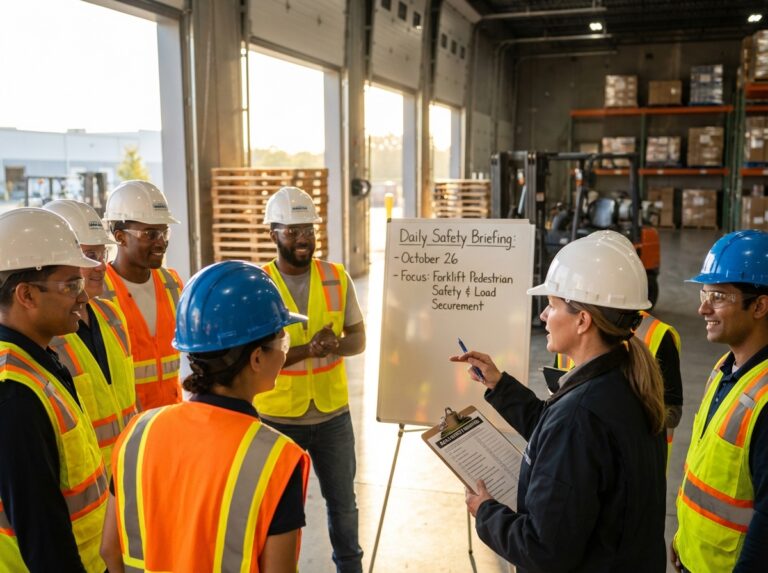
Toolbox talks are short, focused safety meetings that drive hazard awareness and safe behavior across plants, warehouses, and construction sites. This article explores effective topics, preparation checklists, delivery techniques, and measurement methods designed to keep workers engaged, support OSHA-compliant programs, and improve frontline safety performance through practical examples, multilingual approaches, and digital tools for tracking and follow-up.
Engaging Topics, Delivery Techniques, and Practical Tools
Once you have a solid plan, the next step is bringing your toolbox talks to life. The best plan falls flat if the content is irrelevant or the delivery is boring. Workers tune out lectures, but they remember stories, demonstrations, and conversations that connect directly to the hazards they face every day. This means choosing high-impact topics, using proven delivery techniques, and leveraging practical tools to keep things fresh and engaging.
High-Impact Toolbox Talk Topics
Focus on the hazards your crew faces every day. Aligning topics with your site’s specific risks, recent near-misses, or OSHA’s annual top violations list ensures immediate relevance. Here are 14 essential topics for any industrial setting.
Machine Guarding
Rationale
Unguarded or improperly guarded machinery is a primary cause of amputations, lacerations, and crushing injuries. With OSHA’s 29 CFR 1910 Subpart O setting clear requirements, regular reminders are critical to prevent complacency and catastrophic incidents.
- Always perform a pre-use inspection to ensure guards are in place and functional.
- Never bypass or disable safety interlocks. Report any malfunctioning guards immediately.
- Confirm guards are reinstalled correctly after maintenance is completed under lockout-tagout.
Lockout-Tagout (LOTO)
Rationale
LOTO is a life-saving procedure that prevents an estimated 120 fatalities and 50,000 injuries each year. Governed by OSHA standard 29 CFR 1910.147, it is critical for anyone performing maintenance on machinery, as unexpected startup can cause severe crushing injuries and amputations.
- Always identify every energy source before starting work. This includes electrical, hydraulic, pneumatic, and thermal energy. One machine can have multiple sources.
- You are the only person authorized to remove your lock. Never ask someone else to do it, and never remove a lock that isn’t yours. If multiple people are working, each person must apply their own lock.
- Verification is the most important step. After applying your lock and tag, always try to start the machine to confirm it has zero energy. This is your final check that the isolation was successful.
PPE Selection and Use
Rationale
Personal Protective Equipment is the last line of defense against hazards. Incorrect selection, improper fit, or failure to wear PPE can render it useless. Regular talks ensure workers understand not just what to wear, but why and how.
- Match your PPE to the specific task. Are your safety glasses rated for impact? Is your respirator the right type for the chemical?
- Inspect your PPE before every use. Replace gear that is damaged, scratched, or expired.
- Understand the difference between mandatory PPE zones and task-specific PPE requirements.
Fall Protection
Rationale
For the 13th year in a row, Fall Protection is OSHA’s most frequently cited violation, with 7,271 violations in fiscal year 2023. Falls remain a leading cause of death in construction and a serious hazard in warehouses and manufacturing plants, especially around loading docks and mezzanines.
- Inspect your personal fall arrest system before every single use. Check the harness for frayed straps, broken buckles, and pulled stitches. Check lanyards for cuts and ensure the snap hooks lock properly.
- Your anchor point must be rated to support at least 5,000 pounds. Never tie off to a conduit, a pipe rack, or other unrated structures. Always confirm the anchor point is approved.
- Know the site’s rescue plan. If you fall, how will you be rescued? Suspension trauma can set in quickly, so a clear and practiced plan is just as important as the harness itself.
Material Handling and Ergonomics
Rationale
Overexertion from lifting, pushing, and pulling is the number one cause of disabling workplace injuries, costing employers billions annually according to the Liberty Mutual Workplace Safety Index. Proper ergonomic techniques are a simple, effective way to prevent painful and costly musculoskeletal disorders.
- Use mechanical aids like dollies, forklifts, or hoists whenever possible, especially for loads over 50 pounds.
- When lifting manually, keep your back straight, lift with your legs, and keep the load close to your body.
- Plan your route before you lift to ensure it is clear of slip, trip, and fall hazards.
HAZCOM and Chemical Safety
Rationale
Workers have a right to know about the chemical hazards they work with. Under OSHA’s Hazard Communication Standard (29 CFR 1910.1200), understanding labels, pictograms, and Safety Data Sheets (SDS) is essential for preventing chemical burns, respiratory illness, and fires.
- Know the location of the SDS binder or digital access point and how to find information on a specific chemical.
- Read container labels before use to understand hazards and required PPE.
- Understand the basic steps for responding to a small spill in your work area.
Confined Spaces
Rationale
Permit-required confined spaces can contain invisible, life-threatening hazards like toxic gases or low oxygen levels. Strict adherence to entry procedures under 29 CFR 1910.146 is the only way to prevent multiple-fatality incidents, which often occur when would-be rescuers enter unprepared.
- Never enter a permit-required confined space without a completed and signed permit.
- Understand the roles of the entrant, attendant, and entry supervisor. The attendant must never leave their post.
- Always verify atmospheric testing results before entry and understand the continuous monitoring requirements.
Heat Illness
Rationale
As temperatures rise, so does the risk of heat exhaustion and life-threatening heat stroke. Heat illness is entirely preventable with proper controls, making it a critical topic for seasonal or year-round hot environments.
- Drink water frequently throughout your shift, even before you feel thirsty.
- Recognize the signs of heat illness in yourself and your coworkers, like dizziness, headache, and confusion.
- Follow the work/rest schedules established for the current heat index and take breaks in cool, shaded areas.
Struck-By Hazards
Rationale
Struck-by incidents, caused by falling objects or moving equipment, are one of the “Fatal Four” hazards in construction and a major risk in warehouses and plants. Maintaining awareness of your surroundings is key to prevention.
- Always be aware of overhead work. Respect barricades and never walk under a suspended load.
- Wear high-visibility clothing in areas with vehicle or equipment traffic.
- Stack materials securely to prevent them from shifting or falling.
Vehicle and Forklift Safety
Rationale
Powered industrial trucks (governed by OSHA’s 29 CFR 1910.178) were cited 2,561 times in 2023. Incidents involving forklifts often result in severe injuries or fatalities for both operators and pedestrians, making reinforcement of safe practices vital.
- Pedestrians always have the right of way. As an operator, your job is to anticipate pedestrian movement and make eye contact with people on the floor before moving near them.
- Complete your pre-use inspection every day. Check the horn, brakes, lights, and steering. A faulty horn or weak brakes can turn a normal day into a tragedy. Report any issues immediately.
- Keep your forks low when traveling and never travel with an elevated load. This maintains stability and improves your visibility. When parking, lower the forks to the floor and set the brake.
Hand Tool Safety
Rationale
Cuts, punctures, and strains from improper hand tool use are common yet easily avoidable. A quick reminder on tool selection and inspection can prevent many of these nagging injuries.
- Use the right tool for the job. Do not use a screwdriver as a pry bar or a wrench as a hammer.
- Inspect tools before use. Take damaged or worn tools out of service immediately.
- Always cut away from your body and keep your hands out of the line of fire.
Electrical Hazards
Rationale
Contact with electricity can cause burns, neurological damage, or immediate death. Following basic safety rules, including those outlined in NFPA 70E, is essential for all workers, not just electricians.
- Treat all electrical circuits as live until they are properly locked out and verified as de-energized.
- Inspect power cords and tools for damage before use. Do not use equipment with frayed or exposed wires.
- Maintain a safe distance from overhead power lines.
Incident Reporting
Rationale
Reporting near-misses and minor incidents provides valuable data that can prevent a major event from occurring. A strong reporting culture is a sign of a healthy safety program, and toolbox talks can encourage workers to speak up without fear of blame.
- Report all incidents and near-misses immediately, no matter how small they seem.
- Understand that the goal of reporting is to find system weaknesses, not to assign blame.
- Provide clear, factual details in your report to help the investigation identify root causes.
Mental Health and Resilience
Rationale
Stress, fatigue, and distraction are contributing factors in many workplace incidents. Acknowledging the importance of mental well-being and providing resources helps build a supportive culture where workers feel safe to ask for help, improving both personal health and overall site safety.
- Recognize the signs of fatigue and stress in yourself and others. It is okay to not be okay.
- Know where to find resources, such as an Employee Assistance Program (EAP), for confidential support.
- Encourage a culture of checking in on your coworkers and supporting one another.
Delivery Techniques That Boost Engagement
How you deliver the message is just as important as the message itself. To make safety talks stick, you need to engage your audience. This requires moving away from monotone lectures and embracing interactive methods grounded in adult learning principles.
Understanding Adult Learning
Adults learn best when they understand the relevance of the information (“How does this help me stay safe today?”), when the content is delivered in short, focused bursts (brevity), when key messages are repeated over time (repetition), and when they can actively participate rather than passively listen (active learning). Effective delivery techniques incorporate these principles.
- Short Scripts. A one-page script with 3-5 key points keeps the talk focused, consistent, and under five minutes. It is a great tool for new supervisors.
- Storytelling. Share a brief, anonymized story about a recent near-miss on site or a relevant incident from the industry. Stories create an emotional connection and make the lesson more memorable.
- Live Demonstrations. Show, don’t just tell. A quick demonstration of how to properly inspect a harness or apply a lockout device is far more effective than describing it. Keep demos to 10 minutes and ensure the area is safe.
- Hands-On Drills. For critical skills, let workers practice. A 15-minute drill where teams simulate a small spill cleanup or practice hand signals for a crane lift builds muscle memory.
- Question-and-Answer Prompts. Instead of asking, “Any questions?” ask open-ended questions like, “What is the biggest risk when we do this task?” or “Where are the trickiest blind spots for forklifts on this floor?”
- Near-Miss Case Studies. Present a one-page summary of a recent near-miss. Ask the group to identify the root causes and suggest corrective actions. This turns them into active problem-solvers.
- Role-Play. For communication-heavy procedures like confined space entry, a short role-play between the entrant and attendant can clarify responsibilities and build confidence.
- Safety Competitions. Introduce a friendly competition, like a “good catch” of the week award or a team-based safety quiz with a small prize like coffee or lunch.
- Micro-Learning Videos. A 60- to 180-second video can be a powerful way to start a talk. Use it to show a procedure or illustrate a hazard, then lead a discussion. Videos with closed captions are excellent for noisy environments and multilingual crews.
Adapting for a Diverse Workforce
To be effective, safety messages must be understood by everyone. For multilingual crews, provide translated one-page summaries of the talk or use a bilingual facilitator who can interpret in real time. For workers with low literacy, lean heavily on visual aids like photos, pictograms, and live demonstrations to convey the key points. A picture of a correct lifting posture is universally understood.
Practical Tools and Samples
Having ready-to-use templates and checklists makes conducting high-quality talks easier and more consistent.
Sample 5-Minute Script: Lockout-Tagout (LOTO)
(30 seconds) Leader: "Good morning. Today's 5-minute talk is a critical refresher on LOTO. Our goal is to ensure everyone remembers the three key steps: identify, apply, and verify."

(2 minutes) Leader: "First, identify all energy sources for this machine. It's not just electricity. Check for pneumatic or hydraulic lines. (Point to energy sources on a nearby machine). Second, apply your personal lock and tag to the disconnect point. If multiple people are working, use a hasp so everyone can apply their lock. (Hold up a lock, tag, and hasp)."

(1.5 minutes) Leader: "The most important step is third: verify. After your lock is on, try to start the machine at the operator controls. This proves it's at a zero-energy state. Never skip this step."

(1 minute) Leader: "Remember, only you can remove your own lock. If you see any damaged LOTO equipment, report it immediately. Let's sign off on the talk. Stay safe."
Sample 10-Minute Script: Forklift and Pedestrian Safety
(1 minute) Leader: "Alright team, this 10-minute talk is on forklift and pedestrian safety. Last year, OSHA cited over 2,500 violations for powered industrial trucks. We need to stay sharp to keep everyone safe."

(3 minutes) Leader: "For operators, it starts with your pre-use inspection. (Walk over to a parked forklift). Check your tires, forks for cracks, and most importantly, your horn and brakes. If anything is wrong, tag it out of service."

(3 minutes) Leader: "For pedestrians, your job is awareness. Never assume an operator sees you. Make eye contact before crossing a path. Stay out of designated forklift-only aisles. (Point to floor markings). Remember, a forklift's rear end swings wide on turns."

(2 minutes) Leader: "Let's talk about intersections. (Ask the group) What's the rule when a forklift and a pedestrian meet at a blind corner?" (Wait for answers, then confirm) "The operator sounds the horn, and the pedestrian waits to make eye contact before proceeding. Forklifts always move slowly around corners."

(1 minute) Leader: "Great. Let's make sure we're all looking out for each other. Any questions? Okay, let's get the sign-in sheet."
Checklist for Conducting a Toolbox Talk
- Have I chosen a topic relevant to today’s work?
- Do I have 3-5 clear talking points?
- Have I prepared my props or demo equipment? (e.g., LOTO kit, PPE examples)
- Is the meeting area free of hazards?
- Have I prepared the sign-in sheet or digital check-in method?
- Am I ready to ask at least one open-ended question?
- Do I have a plan to capture and assign any corrective actions identified?
Suggested Props and Demo Equipment
- LOTO: Padlocks, tags, hasps, lockbox.
- PPE: Examples of correct and damaged PPE (e.g., scratched safety glasses, worn gloves).
- Fall Protection: A harness and lanyard for inspection demonstration.
- HAZCOM: A sample chemical container with a GHS label and a copy of an SDS.
- Tools: A damaged hand tool and a properly maintained one for comparison.
Leveraging Technology for Better Talks
Modern technology can streamline the administrative side of toolbox talks, freeing up supervisors to focus on delivery. Mobile apps allow for digital checklists, ensuring every step is covered. E-signatures and attendance QR codes create a fast, accurate record of who attended, complete with a timestamp. Simple analytics dashboards can then track key metrics like participation rates and topic frequency, helping you identify which crews might need a refresher on a particular subject.
Keeping Content Fresh and Avoiding Fatigue
Even the best topics can become stale if repeated the same way. To avoid “lecture fatigue,” vary the delivery method. If you used a script last month, do a live demonstration of harness inspection this month. Next quarter, analyze a recent industry case study. You can also change the focus. Instead of a general “fall protection” talk, do a 5-minute talk specifically on anchor point selection, another on calculating fall clearance, and another on inspecting self-retracting lifelines. Getting specific keeps the content fresh. Most importantly, solicit input from your crew. Ask them what hazards they are seeing or what topics they want to cover. A suggestion box or a quick poll can generate relevant topics that workers are already invested in, making them more likely to engage.
Frequently Asked Questions
This section provides clear, direct answers to common operational challenges supervisors and safety managers face when implementing a toolbox talk program.
1. What exactly counts as a toolbox talk? Does a quick two-minute chat with a worker count?
A toolbox talk is a brief, informal safety meeting focused on a single, specific topic. While a quick chat is good, a formal toolbox talk is more structured. To “count,” it should be planned, documented, and cover a specific hazard or procedure relevant to the immediate work. A good rule of thumb is if you can document the date, topic, and who was present, it qualifies. A casual “be careful out there” doesn’t.
2. What is the recommended length and frequency for these talks?
The sweet spot is 5 to 15 minutes. A 5-minute talk is perfect for a simple reminder, like a PPE check. A 10 to 15-minute session allows for a demonstration or a brief hands-on drill. As for frequency, it should be risk-based. For high-hazard operations like confined space entry or hot work, conduct them daily before the shift. For general plant or warehouse operations, weekly is a solid, sustainable rhythm.
3. Does the supervisor always have to be the one leading the talk?
No, and in fact, it’s better if they don’t. While supervisors are a great choice, rotating facilitators is a powerful way to boost engagement and build a stronger safety culture. Encourage experienced frontline workers, safety committee members, or trained peer leaders to take the lead. This gives them ownership and brings fresh perspectives to the crew. The key is ensuring whoever leads is knowledgeable on the topic and comfortable presenting.
4. What are the absolute minimum documentation requirements for OSHA?
OSHA does not have a specific standard called “toolbox talks.” However, many OSHA standards, like Lockout/Tagout (29 CFR 1910.147) or Hazard Communication (29 CFR 1910.1200), require employers to provide and document training. Toolbox talks are an excellent way to fulfill and demonstrate this ongoing training. For an audit, an OSHA compliance officer will want to see proof that training occurred. Best practice for documentation includes these core fields: date, topic, a brief summary of points covered, names or signatures of attendees, and the name of the facilitator.
5. We run multiple shifts and have remote crews. How do we keep everyone on the same page?
This is a common challenge. For multiple shifts, the best approach is to have the outgoing and incoming shift supervisors conduct the talk together during the handoff. If that’s not possible, the supervisor for each shift should deliver the same talk from a standardized script. For remote crews, technology is your friend. You can record a short video of the talk and share it, use a live video call for the meeting, or send a digital one-pager with a quiz and require an e-signature for acknowledgment.
6. How can we effectively engage workers who don’t speak English as their first language?
Engagement hinges on understanding. First, identify the primary languages spoken by your crew. Whenever possible, have a bilingual supervisor or a trusted peer facilitate the talk in that language. If that’s not an option, use simple, translated one-page handouts with lots of pictures and pictograms. For demonstrations, the visual element transcends language. Always pause and ask for a thumbs-up or a nod to confirm understanding rather than just asking, “Any questions?”
7. After an incident, how do we link a toolbox talk to the investigation without it feeling like a blame session?
The focus must be on the system, not the person. Frame the talk around the “lessons learned.” Instead of saying, “Joe didn’t inspect his forklift,” say, “The incident last week highlighted a gap in our pre-use inspection process. We’ve updated the checklist to include checking the horn and backup alarm. Let’s all walk through the new form together.” This approach shares critical information and reinforces that safety is a shared responsibility to fix processes, not punish people.
8. Are toolbox talks coaching tools or disciplinary tools?
They are coaching tools, period. The purpose is to educate, reinforce, and engage. Using attendance sheets to discipline workers will destroy trust and shut down communication. However, the documentation does serve a purpose. If a worker is involved in an incident and claims they were never trained on a specific procedure, your signed toolbox talk record proves otherwise. The discipline would be for the unsafe act, not for failing to listen during the talk.
9. Is it better to use a digital app for records, or are paper sign-in sheets still okay?
Paper is acceptable, but digital is better. Paper sheets are simple but can get lost, are hard to read, and make data analysis nearly impossible. A simple mobile app or digital form allows you to instantly capture timestamped signatures, attach photos of the demonstration, assign corrective actions, and automatically track participation rates. This data becomes invaluable for identifying trends and proving compliance during an audit.
10. Are there privacy or union considerations we need to be aware of?
Yes. For privacy, avoid discussing specific workers’ health issues or past incidents in a group setting. If you take photos or videos, focus on the equipment or process, not the people. If workers are clearly identifiable, it’s best practice to get their consent. Regarding unions, they are your partners in safety. Involve the union safety representative in planning topics and schedules. Review your collective bargaining agreement for any specific language about safety training or meetings. A collaborative approach prevents grievances and builds a unified safety front.
Conclusions and Next Steps
Transforming the principles of effective toolbox talks from theory into practice requires a structured, deliberate approach. A well-executed program doesn’t just happen; it’s built. The following roadmap provides a clear, phased implementation plan for safety leaders ready to move from concept to reality. This plan turns the key takeaways of this article into a series of manageable steps, ensuring your toolbox talk program becomes a cornerstone of your safety culture, not just another item on a checklist.
Your 30/60/90-Day Implementation Roadmap
This plan is designed to build momentum, starting with a small-scale pilot and expanding methodically.
Days 1-30: Launch the Pilot and Gather Baseline Data
The first month is about starting small, proving the concept, and learning what works in your specific environment. The goal is controlled implementation, not perfection.
- Week 1 Quick Wins:
- Select one team or crew for the pilot program. Choose a group with a supportive supervisor.
- Deliver three simple, 5-minute talks on foundational topics like PPE checks, housekeeping, and how to report a near-miss.
- Use a basic paper sign-in sheet to track attendance. This creates an immediate record and establishes the routine.
- Ask for verbal feedback at the end of each talk. What was useful? What was unclear?
- Actions for the First 30 Days:
- Pilot Toolbox Talks: Schedule and deliver talks at least three times a week for the pilot team. Focus on high-risk topics relevant to that team’s work, such as Lockout/Tagout or forklift safety.
- Create Basic Templates: Develop a simple, one-page template for your talks. It should include fields for the topic, date, key talking points, attendees, and a section for noting any hazards or corrective actions identified.
- Establish a Baseline: Before you begin, document the pilot team’s current safety metrics. Note the number of near-misses reported and any recordable incidents from the previous quarter. This data is crucial for measuring impact later.
- Gather Feedback: Actively solicit input from workers and the supervisor. This initial feedback is invaluable for refining your delivery style and topic selection.
Days 31-60: Refine the Process and Train Your People
With a month of experience, you can now focus on building a more robust and sustainable system. This phase is about formalizing processes and empowering others to lead.
- Train Facilitators: Identify and train a small group of supervisors and safety champions to lead toolbox talks. A two-hour workshop covering facilitation skills, how to use the templates, and how to encourage interaction is a great start.
- Develop a Topic Library: Expand your collection of talk templates to cover your site’s top 10-12 risks. Organize them by category (e.g., Fall Protection, Chemical Safety) for easy access.
- Implement Digital Forms: Transition from paper records to a simple digital solution. This could be a mobile app or a shared cloud form. This step streamlines data collection and makes tracking KPIs much easier. Ensure the form captures date, topic, attendees, and corrective actions.
- Review Pilot Data: Analyze the attendance rates and feedback from the first 30 days. Compare the number of near-misses reported by the pilot team to their baseline. Share these early results with the pilot team to show their participation is making a difference.
Days 61-90: Analyze, Scale, and Report
The final phase of the initial rollout focuses on demonstrating value and preparing for a site-wide or enterprise-wide launch. You now have data, trained facilitators, and a proven process.
- Schedule Topics in Advance: Create a three-month rotating topic calendar. Align topics with seasonal risks (like heat illness in summer) or upcoming high-risk projects.
- Build a KPI Dashboard: Develop a simple dashboard to track your key metrics. Present this data to leadership to demonstrate the program’s effectiveness and secure buy-in for a broader rollout.
- Plan the Expansion: Create a plan to scale the program to other departments or sites. This plan should include a timeline for training new facilitators and communicating the launch to all employees.
- Close the Loop: Formalize the process for tracking corrective actions identified during talks. Ensure every action has an owner, a due date, and a clear path to closure.
Measuring What Matters: Key Performance Indicators (KPIs)
To justify and improve your program, you must track its impact. Focus on a mix of leading and lagging indicators.
- Participation Rate: (Number of attendees / Number of scheduled workers) x 100. Aim for a consistent rate of 90% or higher. This measures engagement and reach.
- Corrective Actions Closed: Track the number of hazards identified during talks and the percentage closed within 30 days. Aim for an 80% closure rate. This shows the program is actively reducing risk.
- Near-Miss Reporting Trends: An increase in near-miss reporting is a positive sign of a strengthening safety culture. Target a 20% increase from your baseline within the first 90 days.
- Observed Safe Behaviors: Use safety walkthroughs to observe if behaviors discussed in talks (e.g., proper lifting techniques) are being put into practice. This provides qualitative evidence of the program’s effectiveness.
- Incident Rate Changes: Over the long term (6-12 months), track changes in the incident rates related to the topics you’ve emphasized. This is the ultimate lagging indicator of success.
Continuous Improvement and Sustaining Momentum
A successful toolbox talk program is a living process. Use these strategies to keep it relevant and effective.
- Feedback Loops: Actively solicit topic suggestions from your frontline workers. Use a suggestion box, a dedicated email, or a simple form to gather ideas. When you use a suggested topic, give credit to the person who recommended it.
- Topic and Facilitator Rotation: Keep content fresh by rotating through your topic library and having different trained supervisors lead the talks. This prevents monotony and gives more leaders a chance to engage directly with their teams on safety.
- Leadership Walkthroughs: Ensure senior leaders are visible and participate in toolbox talks regularly. Their presence signals that these meetings are a priority. It also gives them a chance to hear directly from the front line about safety concerns.
Scaling From Pilot to Enterprise
Once your pilot is successful, scaling the program involves standardization and communication. Standardize your digital templates, topic codes, and KPI dashboards across all sites to allow for enterprise-level analytics. Create a communications plan that explains the “why” behind the program and shares success stories from the pilot. Provide central support for training facilitators but allow site-level flexibility to choose topics that address their specific risks.
Practical Resources
You don’t have to start from scratch. These resources provide excellent guidance and materials.
- OSHA Guidance: OSHA provides numerous resources and publications on safety programs. Their QuickTakes newsletters and safety and health topic pages are valuable sources for content.
- NIOSH Materials: The National Institute for Occupational Safety and Health offers in-depth resources on topics like ergonomics, heat stress, and chemical safety that can be adapted for toolbox talks.
- Sample Templates: Many industry associations and EHS software providers offer free toolbox talk templates and topic guides.
By following this structured roadmap, you can build a toolbox talk program that drives real change. The expected outcomes are clear: a more engaged workforce, a proactive hazard reporting culture, and, most importantly, a measurable reduction in workplace incidents.
References
- Death on the Job: The Toll of Neglect, 2024 – AFL-CIO — Workplace hazards kill and injure hundreds of thousands of workers each year.
- Census of Fatal Occupational Injuries Summary, 2022 – U.S. Bureau of Labor Statistics — A total of 5,486 fatal work injuries were recorded in the United States in 2022, a 5.7-percent increase from 5,190 in 2021.
- OSHA’s Top 10 Workplace Safety Violations for 2023 — With 7,271 violations in 2023, Fall Protection isn’t just a persistent problem; it’s a critical focus area. For the 13th consecutive year, it tops the list.
- 2023 Workplace Safety Index – Liberty Mutual — U.S. businesses spent more than a billion dollars a week on the most serious, nonfatal workplace injuries in 2020.
- Injuries, Illnesses, and Fatalities (IIF) Home : U.S. Bureau of Labor Statistics — The IIF program produces a wide range of information about workplace injuries and illnesses.
- OSHA announces preliminary Top 10 Most Frequently Cited Standards for FY 2023 — Fall Protection – General Requirements remains at the top of the list for the 13th year in a row, followed by Hazard Communication and Ladders.