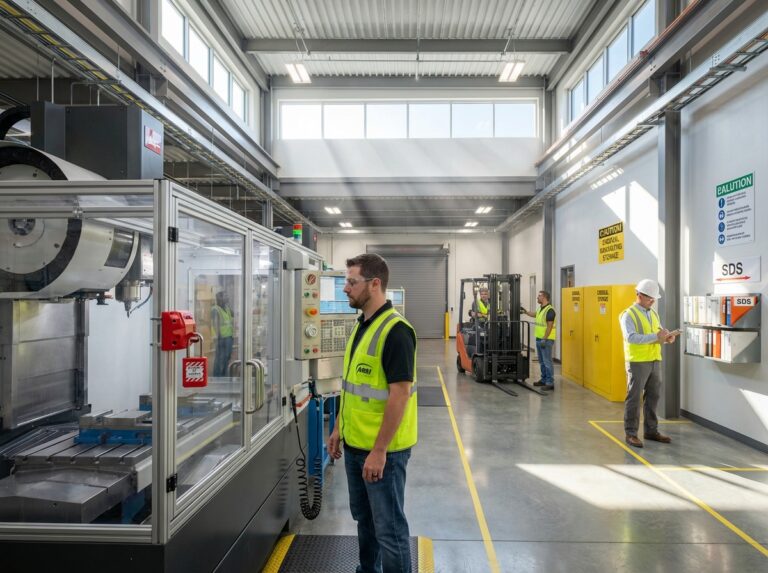
The 2025 OSHA Top 10 list remains a critical roadmap for prevention in industrial workplaces. This article breaks down the most-cited standards, explains root causes across plants, warehouses, and construction sites, and provides actionable checklists, procedures, and training tips to help safety teams prevent citations and reduce incidents. Use these steps to strengthen compliance and protect workers.
Comprehensive Analysis of the 2025 OSHA Top 10 Violations
1. Fall Protection – General Requirements (Standard 1926.501)
Standard 1926.501
This standard remains the most cited for fifteen years straight, with 5,914 violations recorded. Inspectors prioritize identifying workers on roofs, leading edges, or walking surfaces higher than six feet without protection. Common failures include missing guardrails, uncovered floor holes, and skylights, or assuming a short-duration task does not require gear.
Real-world enforcement is strict. For example, a roofing crew in New Jersey was fined $15,000 because they used no anchors while working 20 feet up. Similarly, a crew in Florida was cited for working on a flat roof without a warning line; they believed the distance from the edge was safe, but inspectors measured them within ten feet of the drop. To avoid this, facilities must implement engineering controls like permanent guardrails, administrative controls like restricted access zones, and PPE including full-body harnesses with self-retracting lifelines. OSHA Releases Top 10 Violations for 2025 – Cottingham & Butler.
- Guardrails installed at 42 inches height with midrails at 21 inches.
- Toeboards installed to prevent falling objects.
- Floor holes covered, secured, and covers marked with the word HOLE.
- Anchors rated for 5,000 pounds per worker.
- Harnesses inspected daily for fraying or damage.
- Warning lines set six feet from the edge for roofing work.
- Lanyards selected for the correct length regarding fall distance.
- Safety nets inspected for wear and drop-tested if necessary.
Program Management: Training is required upon initial hire with annual refreshers. Inspections must occur daily before work starts. Documentation requires a written fall protection plan and training logs. The primary KPI target is 100 percent harness compliance during spot checks.
5 Step Fall Protection Plan
1. Identify all fall hazards over 6 feet
2. Select guardrails or personal fall arrest
3. Inspect all equipment before the shift
4. Train workers on specific site hazards
5. Establish a written rescue plan
2. Hazard Communication (Standard 1910.1200)
Standard 1910.1200
With 2,546 violations, this rule focuses on chemical safety and the “Right to Know.” Inspectors frequently cite companies for missing written programs, incomplete Safety Data Sheet (SDS) binders, or unlabeled secondary containers. In a notable case, a cleaning crew in New York mixed chemicals in an unmarked bottle, causing toxic fumes; the company was cited because workers did not know the specific hazards. Engineering controls include proper ventilation and storage cabinets, while administrative controls involve maintaining a rigorous chemical inventory. OSHA’s Top 10 Safety Violations of 2025 – WorkCare.
- Written hazard communication program available to all staff.
- Chemical inventory list updated monthly.
- SDS accessible to all shifts without a password (digital or paper).
- Secondary containers labeled with GHS pictograms and signal words.
- Training records signed by employees.
- Contractors informed of site chemicals before starting work.
- New chemicals reviewed for hazards before entry.
- Emergency eyewash stations functional and tested.
Program Management: Training is required initially and whenever a new hazard is introduced. Inspection cadence involves monthly audits of chemical storage. Documentation must include the written program and the SDS binder. The KPI target is zero unlabeled containers found during audits.
GHS Label Elements
1. Product Identifier
2. Signal Word (Danger or Warning)
3. Hazard Statements
4. Precautionary Statements
5. Pictograms
6. Supplier Information
3. Ladders (Standard 1926.1053)
Standard 1926.1053
There were 2,405 citations for ladders. Inspectors look for structural defects like broken rungs, ladders used for the wrong purpose, or workers standing on the top cap. A maintenance worker fell and broke an arm because they used a ladder that was too short to reach a ten-foot ceiling, forcing them to stand on the top step. The company subsequently replaced all short ladders with taller models and platform ladders. Controls include using the correct ladder type (fiberglass near electricity) and maintaining a 4-to-1 angle. Top 10 OSHA Violations of 2025 – Worksite Medical.
- Side rails extend 3 feet above the upper landing surface.
- Rungs are clean and free of grease, oil, or mud.
- No metal ladders used near power lines.
- Ladder set at a 4-to-1 angle (1 foot out for every 4 feet up).
- Spreaders locked fully on stepladders.
- Top step and top cap never used for standing.
- Broken ladders tagged “Do Not Use” and removed immediately.
- Base placed on level and stable ground.
Program Management: Training is required initially and after any incident. Inspection cadence is before each use. Documentation requires a log of ladder inspections. The KPI target is 95 percent of ladders passing pre-use checks.
4. Lockout/Tagout (Standard 1910.147)
Standard 1910.147
This standard saw 2,177 violations regarding the control of hazardous energy. Citations often occur when companies use generic procedures instead of machine-specific ones, or when workers fail to apply locks. In one incident, an electrician was shocked because a panel was not locked out correctly; another worker re-energized the system. The plant now requires two-person verification for all energy isolation. Controls include individual locks, tags, and specific energy isolation devices. OSHA’s Top 10 Safety Violations for Fiscal Year 2025 – Tyndale USA.
- Machine-specific procedures written for every piece of equipment.
- Authorized employees issued individual locks and keys.
- Affected employees notified before lockout begins.
- All energy sources (electrical, pneumatic, hydraulic) identified.
- Stored energy released or restrained.
- Verification of zero energy state (Try Out) performed.
- Locks and tags removed only by the installer.
- Annual audit of procedures completed and documented.
Program Management: Training is required initially and annually for authorized staff. Inspection cadence is annual for each specific procedure. Documentation requires the written LOTO program and audit records. The KPI target is 100 percent completion of annual audits.
8 Step LOTO Procedure
1. Notify affected employees
2. Shut down equipment
3. Isolate all energy sources
4. Apply locks and tags
5. Release stored energy
6. Verify isolation (Try Out)
7. Perform maintenance
8. Remove devices and restart
5. Respiratory Protection (Standard 1910.134)
Standard 1910.134
Inspectors issued 1,953 citations for respiratory failures. Most involve a lack of medical evaluations or fit testing before use. A painting contractor was cited because workers wore N95 masks without a fit test or medical clearance. They now utilize a mobile clinic for annual testing. Controls include proper ventilation to reduce hazard levels and correct filter selection. OSHA Top 10 Violations: 2025 – Grainger.
- Written respiratory protection program in place.
- Medical clearance obtained for all users prior to fit testing.
- Annual fit test documented for each specific make/model of mask.
- Cartridges selected to match the specific chemical hazard.
- No facial hair interfering with the seal surface.
- Masks stored in clean, sealed bags.
- User seal check performed before every use.
- Valves and straps inspected for cracks or elasticity loss.
Program Management: Training and fit testing are required annually. Inspection cadence is monthly for emergency respirators and before use for daily wear. Documentation requires fit test records and medical clearances. The KPI target is 100 percent fit test completion rate.
6. Fall Protection – Training Requirements (Standard 1926.503)
Standard 1926.503
There were 1,907 citations for training gaps. This standard differs from the general requirement by focusing on worker knowledge. Inspectors interview employees to verify they understand how to use their gear. If a worker cannot explain how to inspect a lanyard or tie off, the company is cited. A roofing firm was fined when workers with harnesses could not demonstrate proper anchor selection. Controls include hands-on demonstrations and written tests.
- Hazard recognition training completed for all workers at heights.
- Correct use and inspection of fall arrest gear demonstrated.
- Anchor point selection criteria understood.
- Fall distance calculations explained.
- Rescue procedures practiced and understood.
- Retraining conducted after any site changes or unsafe behavior.
- Signed training records kept on file.
Program Management: Training frequency is initial plus retraining as needed. Inspection cadence involves quarterly training audits. Documentation requires signed certificates. The KPI target is 100 percent of workers passing a verbal safety quiz during site walks.
7. Scaffolding (Standard 1926.451)
Standard 1926.451
Scaffolding citations reached 1,905. Common issues include missing base plates, incomplete planking, and lack of guardrails. A masonry crew was fined $12,000 for operating on a 15-foot scaffold with no guardrails; they possessed the rails but failed to install them for a “quick job.” Controls include using mud sills for stability and cross-bracing for structure. Commonly Used Statistics | Occupational Safety and Health … – OSHA.
- Level footing with base plates on solid ground (mud sills).
- Scaffold is plumb, square, and cross-braced.
- Fully planked platforms with no gaps greater than 1 inch.
- Guardrails and midrails installed on all open sides.
- Toeboards in place for tool safety.
- Access ladder secured to the frame and clear of debris.
- Ties to the building installed every 20 feet vertically.
- Capacity limits clearly posted.
Program Management: Training is required initially. Inspection cadence is before each work shift by a competent person. Documentation requires the daily inspection tag signed by the competent person. The KPI target is 95 percent of scaffolds passing the first inspection.
Scaffold Daily Inspection Form
1. Footing stable and level
2. Planking secured and full
3. Guardrails and toeboards present
4. Access ladder clear and tied
5. Competent person signature
8. Powered Industrial Trucks (Standard 1910.178)
Standard 1910.178
Inspectors found 1,826 violations for forklifts. Many involve skipping pre-shift inspections or allowing uncertified drivers to operate. A warehouse driver hit a rack because the brakes failed; the driver had skipped the morning check which would have identified the fault. Controls include strict speed limits, floor markings, and digital lockout apps that force inspection before ignition. Top 10 Most Frequently Cited Standards – OSHA.
- Tires inflated and checked for chunks or wear.
- Fluid levels checked for leaks.
- Horn and backup alarm functional.
- Lights working for low-light areas.
- Brakes tested before moving.
- Forks straight, not bent or cracked.
- Seatbelt functional and used by every operator.
- Operator certification current (renewed every 3 years).
Program Management: Training frequency is initial plus evaluation every 3 years. Inspection cadence is daily (or before each shift). Documentation requires the daily check log. The KPI target is zero accidents caused by mechanical failure.
Forklift Operator Daily Checklist
1. Check tires and fluids
2. Test horn and alarms
3. Inspect forks and chains
4. Verify brakes and steering
5. Log results in the daily book
9. Eye and Face Protection (Standard 1926.102)
Standard 1926.102
There were 1,665 citations for eye protection. Workers often wear regular prescription glasses instead of Z87.1 rated safety glasses. In one case, a worker grinding metal suffered an eye injury from a spark because they lacked side shields. The company now provides face shields that clip onto hard hats for double protection. Controls include mandatory PPE zones and prescription inserts. OSHA’s Top 10 Safety Violations Show Persistent Risks to Workers.
- ANSI Z87.1 marking present on all gear.
- Lenses free of deep scratches or pitting.
- Side shields attached to all safety glasses.
- Goggles used for chemical splash or dust risks.
- Face shields used for grinding or cutting tasks.
- Clean storage provided for PPE.
- Proper fit ensured for every worker.
Program Management: Training is initial. Inspection cadence is daily by the worker. Documentation requires a PPE hazard assessment. The KPI target is 100 percent PPE usage in required zones.
10. Machine Guarding (Standard 1910.212)
Standard 1910.212
Machine guarding rounded out the list with 1,239 violations. Inspectors look for bypassed interlocks, missing guards on rotating parts, or removed barriers. A worker reaching into a conveyor to clear a jam was injured because the guard was missing. Similarly, a wood shop was cited because a table saw blade guard was removed to facilitate custom cuts. Controls include fixed guards, light curtains, and interlocks that stop the machine automatically if opened. 2025 OSHA TOP 10 MOST CITED | Schmersal USA/Canada.
- Point of operation guarded effectively.
- Rotating parts (belts, pulleys) covered to prevent contact.
- Guards secured and require tools to remove.
- No sharp edges on the guards themselves.
- Interlocks functional and not bypassed.
- Emergency stops accessible and clearly marked.
- Foot pedals guarded against accidental tripping.
- Anchoring of fixed machinery is secure.
Program Management: Training is initial plus whenever a machine changes. Inspection cadence is weekly safety audits. Documentation requires a machine guarding survey. The KPI target is zero bypassed safety interlocks.
Implementing prevention in plants, warehouses, and construction sites
Building a safety program that actually works requires moving away from the idea that compliance is a separate task. In 2025, the most successful plants and construction sites treat safety as a core part of the production process. When safety is isolated, it becomes a burden that workers try to bypass. When it is integrated, it becomes the standard way to operate.
Risk-Based Inspection Programs
A risk-based approach means you spend your time where the danger is highest. You should use the 2025 Top 10 list to guide your focus. Since fall protection (1926.501) remains the most cited standard with 5,914 violations, your inspections must prioritize work at heights. You can identify critical control points by looking at where your specific operations overlap with these common citations. In a warehouse, this might be the loading dock or high-bay racking. On a construction site, it is the leading edge or the scaffold assembly. You should build your inspection schedule around these high-risk zones rather than doing a generic walk-through of the entire facility every time.
Targeted Checklists for Industrial Settings
Generic checklists often lead to “pencil-whipping” where inspectors just check boxes without looking. You need targeted lists for specific areas.
Assembly Lines
Focus on machine guarding (1910.212) and lockout/tagout (1910.147). Ensure every point of operation is shielded. Verify that workers have their own locks and tags nearby.
Storage and Racking
Check for rack upright damage and proper load labeling. Since powered industrial trucks (1910.178) are a top violation, observe forklift operators for safe speed and floor debris management.
Loading Docks
Inspect dock levelers and vehicle restraints. Ensure fall protection is present for open dock doors.
Elevated Work and Scaffolds
Verify that a competent person inspected the scaffold before the shift. Check for full planking and proper guardrails. For excavation, ensure cave-in protection is in place for any trench deeper than five feet.
Contractor and Subcontractor Management
Your safety record often depends on the people you hire. Prequalification is the first step. You should review their EMR (Experience Modification Rate) and their history of OSHA citations. Contracts must include specific safety clauses that allow you to stop work if hazards are found. On-site oversight is not optional. You should hold daily coordination meetings to discuss how different crews might create risks for each other. If a subcontractor is working above your employees, the fall protection plan must be shared and verified before work starts.
Audit Schedules and Corrective Action
Audits should happen on a predictable schedule, but the follow-up is what matters. You need a system to track corrective actions. This system should record the date the hazard was found, the person responsible for fixing it, and the actual closeout time. If a high-priority hazard like a missing guardrail takes more than 24 hours to fix, your system should alert senior management. Use root cause analysis for recurring issues. If you keep finding broken ladders, the root cause might be a poor procurement process or a lack of storage space, not just worker negligence.
Digital Tools for Compliance
Paper forms are becoming obsolete because they are hard to track. Mobile inspection apps allow supervisors to take photos of hazards and assign repairs instantly. Wearable sensors can alert workers if they enter a restricted zone or if they are using improper lifting techniques. Telematics on forklifts can track impacts and ensure only certified operators can start the vehicle. A digital permit-to-work system ensures that high-risk tasks like hot work or confined space entry cannot begin until every safety check is electronically signed off. These tools provide a digital trail that is invaluable during an OSHA inspection.
Training Program Design
Effective training must be role-specific. A forklift operator needs different information than a maintenance technician. Move beyond classroom lectures. Use competency demonstrations where workers must show they can properly don a harness or apply a lockout device. Hands-on exercises in the actual work environment are more effective than videos. You should assess workers after training to ensure they understood the material. Refresher training should happen annually or whenever a near miss suggests a gap in knowledge.
Measuring Program Effectiveness
You cannot manage what you do not measure. Lagging indicators like injury frequency rates tell you what happened in the past. Leading indicators tell you what might happen in the future.
Leading Indicators
Track near-miss reporting rates, hazard abatement times, and training completion percentages. A high rate of near-miss reporting is actually a good sign because it shows workers are engaged and trust the system.
Lagging Indicators
Monitor total recordable incident rates and days away from work. Compare these to the OSHA Top 10 Safety Violations to see if your incidents align with national trends.
Budgeting and ROI
Safety is an investment that protects your bottom line. When talking to operations leaders, focus on the return on investment. One serious OSHA citation can cost over $16,000. The indirect costs of an injury, such as lost productivity and higher insurance premiums, are often four times the direct costs. Use a prioritization framework to spend your budget. Fix the hazards that could cause fatalities or permanent disabilities first. This usually means investing in fall protection and machine guarding before cosmetic upgrades.
Worker Inclusion and Continuous Improvement
The people doing the work are the best at identifying hazards. Include them in safety committees and encourage them to lead toolbox talks. A behavior observation program where workers coach each other on safe practices can build a stronger culture than top-down enforcement. When workers help design the solutions, they are much more likely to follow the rules. This collaborative approach ensures that your safety program evolves as your operations change.
| Metric Type | Sample KPI | Target Goal |
|---|---|---|
| Leading | Hazard Abatement Time | Under 48 Hours |
| Leading | Training Completion Rate | 100% |
| Leading | Near Miss Reports | 2 Per Month/Dept |
| Lagging | DART Rate | Below Industry Avg |
Frequently Asked Questions: Common concerns answered
What exactly are the Top 10 violations this year and where can I verify them?
The list for 2025 confirms that fall protection remains the most cited standard for the fifteenth year in a row. The top three violations are Fall Protection (1926.501), Hazard Communication (1910.1200), and Ladders (1926.1053). You can verify these rankings and the specific citation counts on the official OSHA Top 10 Most Frequently Cited Standards page. Keeping track of these trends helps you prioritize where to spend your safety budget. For example, knowing that scaffolding moved up to the seventh spot suggests a need for tighter oversight on masonry or roofing sites.
How do I prepare for an OSHA inspection?
Preparation starts long before an inspector knocks on your door. You should conduct regular self-audits using the Top 10 list as a roadmap to find and fix hazards. Designate a specific team member to act as the primary contact for the inspector. This person should know where all safety manuals, training logs, and OSHA 300 forms are kept. Ensure your facility is clean and that all exits are clear. During the walk, take the same photos and notes as the inspector. If they point out a small issue like a blocked fire extinguisher, fix it immediately to show a commitment to safety. Having a binder ready with your written programs for hazard communication and lockout/tagout can make the process much smoother.
What records do I need to show for training, lockout/tagout, and respirator programs?
OSHA inspectors will ask for documentation to prove your programs are active. For training, you need logs that include the date of the session, the name of the instructor, and the signatures of all employees who attended. For Lockout/Tagout (1910.147), you must provide a list of authorized employees and documentation of your annual periodic inspections for each energy control procedure. For respiratory protection (1910.134), you need medical clearance forms for every worker who wears a respirator as well as records of their annual fit tests. Keep these records organized by year and department. Proper record-keeping proves that your safety program exists in practice and not just on paper.
How often must falls, scaffolds, and forklifts be inspected?
The frequency of inspections depends on the specific equipment and the standard that governs it. For powered industrial trucks (1910.178), you must inspect the vehicle before every single shift. If a forklift is used around the clock, it needs an inspection before each new operator takes over. Scaffolds must be inspected by a competent person before each work shift and after any event that could affect their structural integrity (1926.451). Fall protection equipment like harnesses, lanyards, and anchor points should be inspected by the worker before every use. You should also have a competent person perform a more thorough documented inspection of fall gear at least once a year.
Can I contest an OSHA citation and what are typical timelines?
Yes, you have the right to contest any part of a citation. You must submit a written “Notice of Contest” within 15 working days of receiving the official citation and notification of penalty. This 15-day window is strict and includes only business days. If you do not file within this time, the citation becomes a final order and you lose the right to appeal. You can contest the existence of the violation, the proposed penalty amount, or the length of time given for abatement. Many employers choose to have an informal conference with the OSHA Area Director first to discuss potential settlements or penalty reductions.
How do penalties and reductions for abatement work?
OSHA calculates penalties based on the severity of the hazard and the likelihood of an injury. However, they offer several ways to reduce the final fine. Reductions are often available for small businesses with fewer than 250 employees. You can also receive a 25 percent reduction for “good faith” if you can demonstrate an effective, written safety and health program. Another way to lower the penalty is through quick abatement. If you fix the hazard during the inspection or within a very short timeframe, the Area Director may reduce the fine. For example, if an inspector finds a missing machine guard and you install a new one before they leave the site, it shows a proactive attitude.
What constitutes adequate hazard communication labeling and SDS management?
Under standard 1910.1200, every container of hazardous chemicals must have a label that is compliant with the Globally Harmonized System (GHS). This means the label must include a product identifier, a signal word like “Danger” or “Warning,” pictograms, and hazard statements. If you transfer a chemical to a secondary container, that container must also be labeled unless it is for immediate use by the person who filled it. You must also maintain a Safety Data Sheet for every chemical on site. These sheets must be readily accessible to workers in their work areas during every shift. If you use a computer system to store SDS, you must ensure that all employees know how to access the files and that there is a backup method in case of a power failure.
What elements must a written respiratory protection program include?
A written program is required whenever employees must wear respirators to protect their health. According to standard 1910.134, the program must include specific procedures for selecting the right respirators based on the hazards in your workplace. It must also detail the process for medical evaluations to ensure workers are physically able to wear the equipment. Other required elements include procedures for fit testing, cleaning, disinfecting, storing, and inspecting the respirators. You must also include a training component that covers how to use the equipment properly and how to recognize its limitations. A designated program administrator must be named in the document to oversee these tasks.
How can I manage temporary workers and contractors to avoid violations?
OSHA views the safety of temporary workers as a shared responsibility between the staffing agency and the host employer. You must ensure that temporary workers receive the same level of safety training as your permanent staff. This includes site-specific hazards like where to find SDS or how to navigate forklift lanes. For contractors, you should implement a pre-qualification process to check their safety records before they arrive. Include safety requirements in your contracts and conduct a safety orientation on their first day. If you see a contractor performing unsafe work, you have the authority and the responsibility to stop them.
What immediate steps should I take after an OSHA inspection or near miss?
If an inspector finds a violation, start the abatement process immediately. Do not wait for the formal citation to arrive in the mail. Document every step of the repair with photos and receipts. If a near miss occurs, treat it with the same urgency as an actual injury. Conduct a root cause analysis to understand why the event happened. Was it a lack of training, a mechanical failure, or a procedural gap? Once you find the cause, update your written programs and retrain the affected employees. Share the findings with your safety committee to prevent similar issues in other departments. Taking these proactive steps shows a commitment to continuous improvement and can be used as evidence of “good faith” during future inspections.
Final conclusions and practical next steps
Moving from theory to action requires a structured approach that addresses the most frequent hazards found in 2025. The data shows that fall protection remains the primary concern for inspectors. This is followed closely by hazard communication and ladder safety. To reduce the risk of citations, facilities must close the gap between written policies and daily field practices. This means moving beyond simple compliance and focusing on the actual behavior of workers. Prioritizing fall protection involves more than just buying harnesses; it requires active oversight of unprotected edges and consistent training. Hazard communication needs a shift from static binders to accessible digital or physical systems where every employee understands the chemicals they handle. Implementing lockout/tagout and machine guarding controls prevents the amputations that OSHA continues to target through national emphasis programs. Improving electrical safety and respiratory protection rounds out a solid defense against the most common citations.
The 30-60-90 Day Compliance Roadmap
The First 30 Days: Focus on Immediate Hazards
The first month should focus on high-risk areas that trigger immediate fines. Start by performing a comprehensive audit based on the 2025 Top 10 list. Walk through the plant or construction site with the specific goal of finding unprotected edges or missing guardrails. Check every ladder for damage and ensure they are used at the correct angles. Update your training records for fall protection and hazard communication immediately. If workers are using respirators, verify that their fit tests are current and that medical evaluations are on file. Fix any critical PPE deficiencies such as scratched face shields or expired fall lanyards. This initial phase is about removing the “low hanging fruit” that inspectors notice the moment they walk through the gate.
The 60 Day Window: Strengthening Programs
The second month is for administrative and procedural depth. Review all written safety programs to ensure they match current operations. Many citations happen because a written program exists but does not reflect how the work is actually done. Update the Hazard Communication program to include any new chemicals introduced in the last year. Ensure the SDS library is complete and accessible to all shifts. Close out any corrective actions identified during the 30-day audit. This is also the time to review lockout/tagout procedures for every piece of equipment. Verify that authorized employees are following the specific steps for energy isolation and that locks are being used correctly every time.
The 90 Day Goal: Systems and Audits
By the third month, the focus shifts to long-term sustainability. Run a full mock OSHA inspection using a third party or a safety manager from a different site. This provides a fresh set of eyes on the facility. Conduct audits of all contractors working on your site to ensure they follow your safety standards. Implement a digital tracking system for inspections and training to replace manual spreadsheets. This makes it easier to pull records during an actual inspection. Review the effectiveness of machine guarding on all older equipment. Ensure that interlocks are functioning and that guards cannot be easily bypassed by operators. This phase moves the organization from reactive fixing to proactive management.
Immediate Checklist to Reduce Citation Risk
Use this list to identify and fix common issues today. These items represent the most frequent triggers for OSHA citations in 2025.
- Inspect all fall arrest systems for wear or deployment indicators.
- Verify that every chemical container has a legible GHS compliant label.
- Check that ladders extend three feet above the landing surface.
- Ensure all machine guards are in place and secured.
- Confirm that lockout/tagout devices are available and used for all maintenance.
- Check that aisles and exits are clear of obstructions.
- Verify that forklift operators have current certification cards.
- Ensure eye wash stations are accessible and functional.
- Confirm that workers in high noise areas are wearing proper hearing protection.
- Check that all electrical panels have at least 36 inches of clear space in front of them.
Executive Reporting Template for Safety Resources
Use the following structure to justify the budget and personnel needed for these safety improvements. Executives respond best to risk mitigation and cost avoidance data.
| Metric Category | Current Status | Target Goal | Estimated Risk Avoidance |
|---|---|---|---|
| Top 10 Compliance Gap | 65 percent compliant | 100 percent compliant | Avoidance of $16,131 per violation |
| Training Completion | 80 percent current | 100 percent current | Reduction in willful citation risk |
| Open Corrective Actions | 12 items pending | Zero items over 30 days | Lower DART and TRIR rates |
| Equipment Guarding | 90 percent guarded | 100 percent guarded | Prevention of NEP amputation fines |
Ongoing Practices and Program Maintenance
Compliance is not a one-time event. It requires a cadence of regular reviews to stay ahead of regulatory changes. Establish a quarterly audit schedule where different departments are scrutinized for specific Top 10 hazards. Conduct an annual review of all safety programs to ensure they remain relevant to the current workforce and technology. Engaging external consultants is recommended when the facility undergoes major renovations or if there is a history of repeat citations. Legal counsel should be involved if an inspection results in serious or willful citations to manage the contest process. Always verify any regulatory changes in 2025 before implementing new procedures. OSHA often updates interpretations or enforcement weights throughout the year. Staying informed through official channels ensures that your safety performance continues to improve and your workers remain protected from the most common industry risks.
For detailed templates and model programs, refer to the OSHA Top 10 Most Frequently Cited Standards and the Grainger OSHA Top 10 Violations 2025 guide. These resources provide the specific language needed for compliant written programs and training modules.
Sources
- OSHA Releases Top 10 Violations for 2025 – Cottingham & Butler — For 2025, the top 10 most cited standards were as follows: · Fall protection – General requirements (1926.501): 5,914 total violations · Hazard …
- OSHA's Top 10 Safety Violations of 2025 – WorkCare — OSHA's Top 10 Most Frequently Cited Violations, FY 2025 · Fall Protection – 5,914 citations · Hazard Communication – 2,546 citations · Ladders – …
- Top 10 OSHA Violations of 2025 – Worksite Medical — OSHA's Top 10 Violations for 2025 · Fall Protection – General Requirements: 5,914 violations · Hazard Communication: 2,546 violations · Ladders: …
- 2025 OSHA TOP 10 MOST CITED | Schmersal USA/Canada — 2025 OSHA TOP 10 MOST CITED · Fall Protection – General Requirements (1926.501): 5,914 violations · Hazard Communication (1910.1200): 2,546 …
- OSHA's Top 10 Safety Violations Show Persistent Risks to Workers — 1. Fall Protection – General Requirements (1926.501): 5,914 violations · 2. Hazard Communication (1910.1200): 2,546 · 3. Ladders (1926.1053): …
- Commonly Used Statistics | Occupational Safety and Health … – OSHA — Most frequently violated standards. The following are the top 10 most frequently cited standards by Federal OSHA in fiscal year 2024 (October 1, 2023, through …
- Top 10 Most Frequently Cited Standards – OSHA — The following is a list of the top 10 most frequently cited standards following inspections of worksites by federal OSHA for all industries.
- OSHA's Top 10 Safety Violations for Fiscal Year 2025 – Tyndale USA — Fall Protection—General Requirements: 5,914 · Hazard Communication: 2,546 · Ladders: 2,405 · Lockout/Tagout: 2,177 · Respiratory Protection: 1,953 …
- OSHA Top 10 Violations: 2025 – Grainger — 1. Fall Protection – General Requirements (1926.501) · 2. Hazard Communication (1910.1200) · 3. Ladders (1926.1053) · 4. Lockout/Tagout (1910.147) …
EMPTY