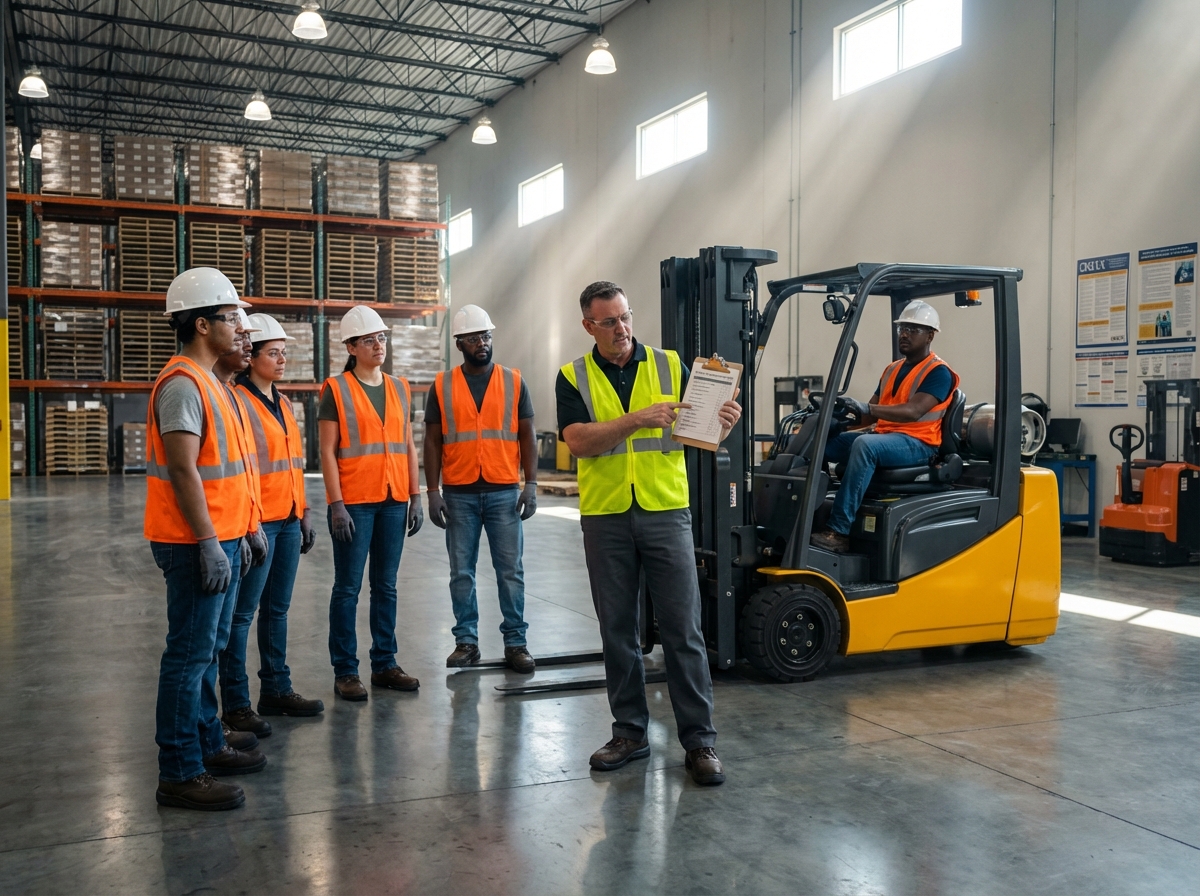
Forklift safety certification is a cornerstone of industrial workplace safety in plants, warehouses, and construction sites. This article explains U.S. regulatory expectations, employer and trainer responsibilities, practical training program design, assessment and recordkeeping, and modern tools to improve operator competence and reduce incidents across facilities.
Regulatory Framework and Legal Responsibilities in the United States
The legal landscape for operating powered industrial trucks in the United States rests on a specific set of federal rules. The primary regulation is 29 CFR 1910.178(l). This standard dictates that every employer must ensure their forklift operators are competent. Competence is not a vague suggestion. It is a legal requirement proven through successful completion of training and evaluation. The responsibility for this falls entirely on the employer. You cannot rely on a worker simply saying they have experience. You must verify it through a structured process.
Federal OSHA sets the floor for safety. Many states operate their own OSHA-approved plans. These state plans must be at least as effective as the federal version. Some states choose to be much stricter. California is a notable example. Cal-OSHA requires more detailed record-keeping than the federal standard. It also has explicit requirements for seatbelt use that go beyond the general duty clause often used by federal inspectors. If you operate in a state with its own plan, you must follow those specific rules. They often carry higher penalties for oversight.
Industry best practices come from the American National Standards Institute and the Industrial Truck Standards Development Foundation. The ANSI/ITSDF B56 series provides the technical details that OSHA regulations sometimes lack. For example, ANSI/ITSDF B56.1 covers low lift and high lift trucks. These standards explain the physics of truck stability and the nuances of load handling. While OSHA is the law, ANSI is the benchmark for what a “qualified” person should know. Courts and inspectors often look to these consensus standards to determine if an employer followed industry best practices.
The term forklift certification is often misunderstood. In the eyes of the law, there is no such thing as a government-issued forklift license. OSHA does not hand out cards. A certification is simply a record created by the employer. It states that the employee has received the required training and has been evaluated while operating the equipment. This record must include the name of the operator, the date of the training, the date of the evaluation, and the identity of the person performing the evaluation.
Financial Risks of Noncompliance
Ignoring these rules leads to heavy fines. As of late 2025, the penalty amounts reflect the serious nature of workplace safety. Note that federal “Serious” violations are capped at the same level as “Other-than-Serious” violations, though the gravity of the citation differs.
| Violation Type | Maximum Federal Penalty | Maximum Cal-OSHA Penalty |
|---|---|---|
| General/Other-than-Serious | $16,285 | $16,285 |
| Serious Violation | $16,285 | $18,000+ (varies by statute) |
| Willful or Repeated | $162,851 | $162,851 |
A single untrained operator can trigger a five-figure fine. In one recent case, a warehouse manager faced a citation exceeding $10,000 for just one employee who lacked proper documentation.
Interpreting Rules Across Different Sites
The regulation applies to all powered industrial trucks. This includes sit-down counterbalanced forklifts, narrow-aisle reach trucks, order pickers, and even electric pallet jacks. You must tailor your training to the specific equipment and the specific environment. A warehouse with smooth floors and high racking requires different safety protocols than a construction site with rough terrain.
Outdoor operations involve weather hazards and uneven ground. Manufacturing plants often have high pedestrian traffic and noise. You must address these site-specific hazards in your training program. If an operator moves from a sit-down forklift to a stand-up reach truck, they need new training. The controls are different. The stability characteristics are different. You cannot assume proficiency on one translates to the other.
Triggers for Refresher Training
Training is not a one-time event. OSHA requires a performance evaluation at least once every three years. However, certain events trigger immediate refresher training regardless of where the operator is in that three-year cycle:
- The operator is involved in an accident or a near-miss incident.
- The operator is observed operating the vehicle in an unsafe manner.
- The operator receives an evaluation that reveals they are not operating the truck safely.
- The operator is assigned to drive a different type of truck.
- A condition in the workplace changes in a way that could affect safe operation (e.g., new racking, different floor surface).
Employer Compliance Checklist
Use this list to verify your current standing with federal requirements.
- Confirm all operators are at least 18 years old.
- Verify each operator has completed formal instruction through lectures, videos, or online courses.
- Ensure every operator has finished hands-on practical training under supervision.
- Conduct a formal performance evaluation for every operator on the specific equipment they use.
- Maintain written records including the operator name, trainer name, and dates of completion.
- Schedule re-evaluations for all staff at least every three years.
- Provide site-specific training for unique hazards like ramps, docks, or narrow aisles.
For more detailed guidance on maintaining these standards, you can review the Powered Industrial Trucks – Forklifts – Overview – OSHA page. If you are managing operations in California, check the specific differences in the Cal-OSHA vs Federal OSHA Forklift Requirements 2025 guide. Always check for the latest updates to these standards as of December 2025 to ensure your safety program remains current. Legal responsibility stays with the employer to prove that every person behind the wheel is fully prepared for the task.
Employer Duties and the Operator Certification Process
Employers carry the full legal weight of ensuring every forklift operator is competent. This responsibility cannot be outsourced to a third party entirely. While an employee might arrive with a certificate from a previous job or a staffing agency, that document does not grant them the right to operate equipment at a new site. The current employer must verify their skills on the specific machines and in the specific environment where they will work.
This duty applies to all businesses, regardless of size. Even small business owners who occasionally operate a lift must maintain written certification records. The process starts with identifying who needs training. Any employee who will operate a powered industrial truck even occasionally must be at least 18 years old. This age limit is a firm requirement under the Fair Labor Standards Act for non-agricultural work.
The Operator Qualification Path
Initial Assessment
Before training begins, managers should check the experience level of the trainee. A worker who has never touched a lift requires a different pace than a veteran operator. This stage helps determine if the training will be conducted internally or through an outside provider. Many companies use online courses for the theory portion. For example, the OSHA Forklift Certification Training provides the necessary formal instruction. However, the employer must still provide the hands-on portion at the facility.
Formal Instruction
This stage covers the physics of the machine. It includes the stability triangle, load capacity, and the differences between a car and a forklift. Trainees must learn about the specific fuel systems they will handle. For electric forklifts, this includes battery positioning and the use of PPE like acid-resistant gloves and face shields. For internal combustion engines, operators must know how to safely handle propane tanks, check for leaks, and use proper lifting techniques for heavy tanks. If the forklift uses attachments like clamps or carpet poles, the instruction must cover how these change the center of gravity. A written test is usually the final part of this stage. A score of at least 70 percent is the standard benchmark for passing.
Practical Training and Evaluation
Once the theory is finished, the trainee moves to the actual equipment. This must happen under the direct supervision of a person who has the knowledge to train others. The trainee practices basic maneuvers in a safe area without pedestrians. After they show confidence, a formal evaluation takes place. The evaluator watches the operator perform typical tasks like picking a load from a high rack or navigating a loading dock. This evaluation must be documented to prove the operator is competent in the actual workplace.
Managing Timelines and Refreshers
OSHA requires a performance evaluation at least once every three years. This is the maximum interval. Many high-risk environments choose to do this annually. As noted in the regulatory section, events such as accidents, near-misses, or changes in equipment types trigger immediate refresher training regardless of the three-year schedule. You can find a detailed list of these triggers in the OSHA Forklift Certification Requirements 2025 Checklist.
Handling Temporary and Subcontractor Staff
Staffing agencies often provide “certified” workers. The host employer still holds the duty to ensure these workers are safe on their specific site. You should ask the agency for copies of the training records. Once the worker arrives, a qualified person at your facility must conduct a site-specific evaluation. This ensures the temporary worker understands your floor markings, pedestrian zones, and unique hazards like steep ramps or low overhead clearances. Never assume an external certificate covers your specific safety protocols.
Documentation and Policy Standards
A written policy is the foundation of a safe program. It should state that no one operates a lift without current certification. It should also outline the steps for battery maintenance and daily inspections. Documentation must be kept on file for the duration of the operator’s employment. These records are the first thing an inspector will ask to see during a visit.
Sample Operator Training Record
The following fields should be included in your digital or paper filing system.
| Data Field | Required Information |
|---|---|
| Operator Name | Full legal name of the employee |
| Training Date | Date the formal instruction was completed |
| Evaluation Date | Date the hands-on performance was approved |
| Trainer Name | Identity of the person who conducted the training |
| Equipment Type | Specific class and model of the forklift used |
| Pass/Fail Result | Outcome of the practical skill assessment |
Sample Employer Policy Language
You can adapt this text for your safety manual.
All powered industrial truck operators must complete formal instruction and a practical evaluation before assignment.
Certification is specific to the equipment type and the workplace hazards.
Refresher training will occur every three years or immediately following any safety incident.
Daily pre-shift inspections are mandatory for all equipment.
Unauthorized operation of a forklift will result in disciplinary action.
Site-Specific Hazards and Attachments
Training is not complete if it only covers the machine. The environment is just as important. Operators must be trained on the specific hazards of the facility. This includes narrow aisles, pedestrian crossings, and areas with poor lighting. If the workplace has loading docks, the training must cover trailer chocking and dock plate safety. When attachments are added to a forklift, the manufacturer’s capacity plate must be updated. Operators must be trained to read these new plates. They need to understand that an attachment usually reduces the maximum lifting capacity and changes how the truck handles when empty.
Designing Effective Training Programs for Operators and Trainers
Building a training program that actually sticks requires moving away from passive lectures. Adult learners process information best when they understand the immediate relevance of the material to their daily tasks. This means the curriculum must focus on problem solving and real world scenarios rather than just reciting regulations. When you design these programs, you are creating a foundation for a culture where safety is a conscious choice rather than a checklist.
Core Curriculum for Operators
The formal instruction phase must cover the physics of the machine and the rules of the road. You should include detailed modules on the stability triangle and the center of gravity. Operators need to understand how load center changes affect the risk of a tip over. Other essential topics include pedestrian awareness and emergency procedures like what to do during a lateral tip. You can find a detailed list of these topics in this OSHA Forklift Certification Requirements 2025 | Complete Checklist. Formal instruction can happen through lectures or written materials.
Hands-On Skill Modules
Practical training is where the theory meets the warehouse floor. Every operator must master the pre-use inspection to identify hydraulic leaks or worn tires before the shift starts. Basic maneuvers should include driving in forward and reverse while navigating tight turns. Stacking and unstacking modules must require trainees to handle loads at various heights. If your facility has inclines, include specific training on ramp use. For outdoor operations, add rough terrain techniques to ensure the operator knows how to handle uneven surfaces safely.
Trainer Preparation and Qualifications
Required Knowledge and Skills
A person who is a great driver is not always a great teacher. OSHA does not mandate a specific trainer certificate, but it does require that trainers have the knowledge, training, and experience to train operators and evaluate their competence. Trainers must have a deep familiarity with OSHA 1910.178 and ANSI B56.1 standards. They need the ability to perform a job hazard analysis to identify risks specific to your facility. Beyond technical knowledge, they must possess pedagogical techniques for adult learners. This includes knowing how to give constructive feedback without discouraging the trainee. They must be competent in practical evaluation and able to use objective rubrics to grade performance.
Trainer Instructional Skills
Effective trainers use behavioral observation to spot unsafe habits before they become permanent. They should be able to coach operators through difficult maneuvers by breaking down complex actions into smaller steps. Documented experience is vital. You should keep records showing the trainer has the background necessary to evaluate others. This ensures that the person signing off on the certification is truly qualified to judge competence.
Sample Training Schedules
| Day | Operator Course Module | Trainer Module Focus |
|---|---|---|
| Day One | Classroom theory and stability physics | Adult learning principles and coaching |
| Day One | Written knowledge assessment | How to perform a job hazard analysis |
| Day Two | Hands-on maneuvers and stacking | Conducting practical evaluations |
| Day Two | Final performance evaluation | Giving corrective feedback sessions |
Technology and Blended Learning
Integrating Modern Tools
Blended learning combines the flexibility of digital tools with the necessity of in-person practice. E-learning is excellent for the formal instruction phase. Many companies use a Forklift Certification Training | 100% Online Course to cover the basics before the student ever touches a machine. Virtual reality (VR) simulations can help trainees build muscle memory for controls in a zero risk environment. However, technology is only a supplement. OSHA mandates that the final skill demonstration and evaluation must happen in person on the actual equipment the employee will use.
Accommodations for Diverse Workers
Your program must be accessible to everyone in your workforce. This includes providing materials in multiple languages if your operators are not native English speakers. For workers with lower literacy levels, use visual aids and verbal testing. If an operator has a physical disability, you must evaluate if they can safely operate the specific equipment with or without reasonable accommodations. The goal is to ensure every worker fully understands the safety requirements regardless of their background.
Site-Specific Hazard Integration
The most dangerous hazards are often the ones unique to your building. Training must be customized to include your specific floor plan and environmental conditions. If you have low overhead clearances or high traffic intersections, these must be part of the practical exercises. Use a site-specific hazards worksheet to ensure nothing is missed during the training session.
SITE-SPECIFIC HAZARDS WORKSHEET
Facility Name:
Date of Analysis:

1. Pedestrian Zones: Identify high-traffic walkways.
2. Surface Conditions: Note ramps, dock plates, or oily floors.
3. Overhead Obstructions: List low pipes or mezzanine edges.
4. Environmental Factors: Note poor lighting or noise levels.
5. Load Specifics: Describe unique pallet sizes or hazardous materials.
6. Equipment Types: List specific attachments like paper roll clamps.
Integrating these details into the curriculum ensures that operators are not just certified in a general sense. They become competent in the specific environment where they work every day. This approach bridges the gap between basic compliance and a truly safe workplace.
Assessment Documentation Recertification and Field Implementation
A valid practical evaluation happens in the actual environment where the operator works. It is not enough to drive in a circle in an empty parking lot. The trainer needs to watch the operator perform a full pre-shift inspection. This includes checking hydraulic fluid levels, tire condition, and mast operation. During the driving portion, the trainer uses a checklist with objective criteria. For example, did the operator sound the horn at every intersection? Did they keep the forks at the correct height while traveling? Scoring should be clear. Many companies use a point system where certain safety violations result in an automatic failure. A written test is also necessary. Most programs require a score of at least 70 percent to pass the theoretical portion. You can find more details on these steps in the OSHA Forklift Certification Requirements 2025 | Complete Checklist.
Documentation and Record Retention
Certification Records
OSHA 1910.178(l) requires the employer to certify that each operator has been trained and evaluated. This record must include the name of the operator, the date of the training, the date of the evaluation, and the identity of the person performing the training or evaluation. While federal rules do not set a specific time for keeping these files, maintaining them for at least three years is the industry standard. This matches the three year re-evaluation cycle. Digital backups are highly recommended to prevent loss during audits. Written knowledge tests should be filed alongside the practical evaluation sheets to provide a complete picture of the operator’s competence.
| Record Type | Required Fields | Recommended Retention |
|---|---|---|
| Practical Evaluation | Operator Name, Date, Forklift Type, Trainer ID | 3 Years Minimum |
| Written Test | Score (70% min), Date, Topics Covered | 3 Years Minimum |
| Trainer Credentials | Knowledge, Training, Experience Proof | Duration of Employment |
Refresher Training and Re-evaluation Triggers
Baseline and Immediate Triggers
Refresher training is not just a calendar event. While a three year check is the baseline, several events trigger immediate re-evaluation. If an operator is involved in an accident or a near miss, they must go back to training. Observing an operator driving unsafely or receiving a poor evaluation also requires a refresher. Changes in the workplace or the introduction of a different type of forklift are other common triggers. This ensures that skills stay sharp as the environment evolves. Trainers themselves should be re-evaluated periodically to ensure they are still following current safety standards and using effective teaching methods.
Program Audits and Performance KPIs
Measuring Effectiveness
Internal audits of the training program help identify gaps before they lead to accidents. Using incident data and telematics can highlight high risk behaviors like speeding or harsh braking. These data points allow safety managers to target specific areas for improvement. Key Performance Indicators (KPIs) provide a measurable way to track success. Common KPIs include the incident rate per operating hour, the number of near misses reported, and the passing rate on initial evaluations. If many operators fail the practical skills portion because of load handling, the training should focus more on stability and center of gravity.
On-Site Implementation Best Practices
Scheduling and Coordination
Running a program in a busy warehouse requires coordination. Scheduling operators during slow production hours helps maintain output without rushing the training. Trainers must work with the maintenance department to ensure forklifts are available and batteries are charged for the hands on portion. PPE coordination is vital. Every trainee needs a high visibility vest and steel toe boots before they step onto the floor. Contractor and subcontractor management is another layer. Employers must verify that any outside workers have valid certifications that meet the specific site hazards of the facility.
Remediation and Corrective Action Plans
Handling Failures
Failing an evaluation should lead to a corrective action plan. This plan might include one on one coaching sessions focused on the specific skills that were missed. For example, if an operator struggles with stacking at heights, they should spend extra time practicing that maneuver under direct supervision. A formal re-test follows the coaching. If unsafe behavior continues despite remediation, a disciplinary pathway should be followed. This ensures that only competent people operate heavy machinery. Documentation of these coaching sessions is just as important as the initial certification. It shows a commitment to safety and a proactive approach to risk management.
- Coaching Session. Focused practice on failed maneuvers.
- Supervised Operation. Temporary restriction to low risk areas.
- Re-testing. Full practical evaluation after coaching is complete.
- Final Review. Safety manager sign off before returning to full duty.
Final conclusions and practical next steps
Moving toward the end of 2025, the landscape of industrial safety continues to demand more than just basic compliance. We have seen that forklift safety is not a one-time event but a continuous cycle of education as well as verification. For employers and safety managers, the legal obligation remains clear under OSHA 1910.178. You are responsible for ensuring that every operator is competent before they ever touch a piece of equipment alone. This responsibility cannot be delegated to a third party entirely. Even if you use outside training, the final evaluation must happen at your facility on the specific equipment your team uses every day.
A compliant program rests on three specific pillars. First, you have formal instruction which can include lectures, written materials, or online modules. Second, you must provide practical training where the operator performs maneuvers under direct supervision. Finally, a performance evaluation is required to prove the operator can handle the machine safely in your specific environment. Skipping any of these steps leaves your organization open to significant liability. Federal penalties for serious violations can reach over $16,000, while willful violations might exceed $162,000. These figures represent more than just a financial hit. They reflect the high stakes of workplace safety.
The Role of the Qualified Trainer
The person leading your training program must be a qualified person. OSHA does not require a specific degree or a government license for trainers. Instead, they look for a combination of knowledge, training, and experience. A qualified trainer understands the physics of forklift stability as well as the nuances of your specific warehouse layout. They must be able to demonstrate safe operation and accurately judge the skills of others. If your trainer has not stayed current with the latest ANSI standards or the 2025 OSHA updates, your entire certification process might be at risk. It is often beneficial to put your internal trainers through a professional train the trainer program to ensure they have the pedagogical skills to teach effectively.
Documentation and Evaluation Standards
If a safety event occurs, your documentation is your primary defense. OSHA requires written records that include the name of the operator, the date of the training, the date of the evaluation, and the identity of the person performing the evaluation. Many managers find it helpful to keep these records for at least three years, which aligns with the mandatory re-evaluation cycle. You should also document the specific types of equipment the operator is cleared to use. An operator certified on a sit down counterbalanced truck is not automatically qualified to run a stand up reach truck or a specialized turret lift. Each class of equipment requires its own practical evaluation.
Integrating Modern Safety Tools
Technology has changed how we approach certification in 2025. Virtual Reality (VR) is now a common tool for the initial stages of training. It allows new operators to practice in a risk-free environment before they step onto a real warehouse floor. Blended learning models, which combine online theory with on-site practice, offer flexibility for busy operations. However, these tools must supplement rather than replace hands-on experience. Telematics systems are also becoming essential. These systems track impacts as well as unsafe driving habits in real time. This data provides a perfect roadmap for when an operator needs refresher training before the three-year mark. If the data shows a pattern of near-misses or harsh braking, you have a legal and moral obligation to intervene with additional instruction.
For those looking for structured guidance, the OSHA Forklift Certification Requirements 2025 | Complete Checklist provides a clear path for staying compliant. You can also find comprehensive resources through the Forklift Certification Training portal which offers online theory options that satisfy the formal instruction requirement. Always remember that the employer must provide the final hands-on evaluation at the actual job site.
30-90 Day Action Checklist
Audit Existing Records
Review every operator file to ensure no one has exceeded the three-year evaluation window. Check that each record includes the trainer name and the specific equipment type. Identify any gaps in documentation immediately.
Verify Trainer Credentials
Confirm that your internal trainers have documented proof of their own training and experience. If they have not attended a refresher in several years, schedule them for a professional development course to stay current with 2026 standards.
Update Site-Specific Hazards
Walk your facility to identify new hazards such as changed floor layouts, new racking systems, or increased pedestrian traffic. Incorporate these specific risks into your next practical evaluation session.
Map Equipment Classes
Create a matrix of every forklift type in your fleet. Cross-reference this with your operator list to ensure everyone is only operating the machines they were specifically evaluated on.
Review Telematics and Incident Logs
Analyze your recent safety data to see if any operators require immediate refresher training due to unsafe habits or near-misses. Use this data to prioritize your training schedule for the next quarter.
Maintaining a high standard for forklift certification is a heavy lift, but it is the most effective way to prevent workplace injuries. By focusing on qualified instruction, rigorous evaluation, and meticulous record-keeping, you create a safer environment for everyone. Stay proactive by regularly checking the latest How to Get Your Forklift License in 2025 guides to ensure your program remains at the forefront of industry best practices.
Sources
- OSHA Forklift Certification Requirements 2025 | Complete Checklist — Minimum Age: Operators must be at least 18 years old. Formal Instruction: Includes online training, video, lecture, or written materials.
- OSHA Forklift Certification Training 2025 – Coggno — A. Yes, written records of forklift certification are required. Employers must maintain records of their forklift operators' certifications, …
- OSHA Forklift Certification Requirements & Training Rules — Operators must complete certified training, participate in practical assessments, and receive formal certification to comply with OSHA standards.
- Cal-OSHA vs Federal OSHA Forklift Requirements 2025 — Federal regulations mandate forklift operator training and evaluation every three years. Training must cover powered industrial trucks (PITs) including …
- National Forklift Foundation: Official OSHA Online Forklift Certification — What are the requirements? · Completing a formal instructional & educational training class that meets OSHA 1910.178 standards · Completing a formal evaluation ( …
- How to Get Your Forklift License in 2025 (The Ultimate Guide) — … forklift operator license, OSHA says that you must receive: Formal instruction. Hands-on training and evaluation. Certification. We call …
- Powered Industrial Trucks (Forklift) – Training Assistance – OSHA — All powered industrial truck operators must be trained and certified by their organizations. [29 CFR 1910.178(l)]
- Powered Industrial Trucks – Forklifts – Overview – OSHA — Employers must ensure that each powered industrial truck operator is competent to operate a powered industrial truck safely, as demonstrated by the successful …
- Forklift Certification Training | 100% Online Course — You must score at least 70% to pass the exam. After you successfully pass the final exam, OSHA requires you to receive hands-on training from your employer and …
EMPTY